

The Malaysian Innovators: H. N. Ridley

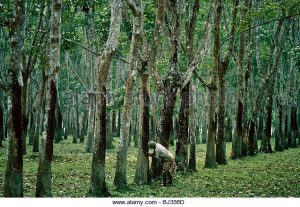
A rubber plantation in Malaysia

Background 

Today, not many people

would know H. N. Ridley. As a Malaysian business and innovation historian,  I had studied the development of Malaysian major industries. I noted, in each industry, there was a notable industry champion. Of all the Malaysian industries, plantation rubber had the most economic impact on British Malaya (Malaysia before independence in 1957), and the development of the rubber plantation industry can be attributed to one individual, namely H. N. Ridley.

Many historians would agree that the economic foundation of British Malaysia in late 1800s and early 1900s was built on the plantation rubber industry. When the motorcar industry was emerging in Europe and US there was a huge demand for rubber latex to produce tires. Then, the supply of rubber latex, which was tapped from wild rubber trees in the Amazon jungle in South America, was not enough to meet the need of the fast growing tire producing companies.Thus, efforts were made to produce rubber latex under plantations. British planters were already planting coffee plants in large estates in British Malaya and Ceylon.British Malaya and Ceylon had the suitable climate for the rubber trees found in the Amazon jungle. In 1876, the British government of India assisted Henry Wickham to buy 70,000 seeds (at 10 Pounds per 100 rubber seeds). He chartered a ship, SS Amazons, to export the rubber seeds, with the goodwill and co-operation of the Brazilian government, to Kew Gardens in London, where 2,800 germinated. Most of the germinated seeds were sent to Ceylon, and a few to Singapore and Java.

In 1888, H. N. Ridley came to Singapore and was appointed the Director of the Singapore Botanic Garden. During his tenure of twenty three years, H. N. Ridley became a fervent champion of the rubber plantation industry and earned him the nickname, “Mad Ridley”. There were many challenges facing the early plantation rubber industry in the late 1800s. One of them was convincing the local British and Chinese planters to switch from coffee bushes to rubber trees. Another was to extract rubber latex from the rubber trees without damaging them. Ridley spent many years promoting rubber trees as a commercial crop. He gave away rubber seeds when he met the coffee planters. Notable planters who shared his vision included Tan Chay Yan and the  Kindersley brothers. These planters were the first group of planters who planted rubber trees on their estates. He also established a technique to harvest rubber latex without damaging the rubber trees.
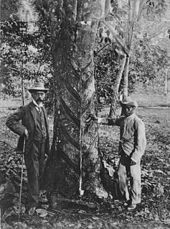
Mr. Ridley and his assistant in front of the rubber tree in Singapore

By the early 1900s, the rubber plantation industry had significant areas planted with rubber trees. By 1910, British Malaya became an important rubber producer, riding on the rapid growth of the motorcar industry in Europe and US., and H. N. Ridley’s dream fulfilled. More important was that the rubber plantation industry opened vast areas in British Malaya where rubber trees were planted in large estates by British-owned companies. They obtained capital from the listing of their shares on the London Stock Exchange. Rubber trees were also planted by villagers in smallholdings. It seemed that everyone in British Malaya planted rubber trees, and every investor in London owned shares of rubber companies.

Lesson Learned

The emergence of the rubber plantation industry  showed the need of commitment and efforts of an  industry champion such as H. N. Ridley who believed in the potential of the rubber plantation industry. He also helped in solving the various technical problems facing the nascent rubber plantation industry.  Many industries also had such industry champions.

Rubber latex flowing into a cup

British Malaya became a prominent producer of an important industrial material in the early 1900s. Now, Malaysia can again became an important producer of products that the world needs, but we need industry champions of the calibre of H. N. Ridley. He lived long enough to see the growth of the rubber industry when he passed away on 24th, October, 1956.

We hope new Malaysian industry champions will rise!!

The Unintended Benefits of Driverless Car Technology

Introduction

Buy brewers. Buy distillers. Buy restaurant companies. This was the conclusion the other day from stock market analysts at Morgan Stanley, who predicted that the arrival of the era of driverless cars would trigger a significant pick-up in alcohol consumption.

Autonomous vehicles and ride-sharing technology will enable us to glug more than ever, the American investment bank’s analysts argued. There would be “more opportunities to drink before getting into the car” and “more opportunities to drink while in the car”.

For drivers, the hours of down time spent staying dry because of the tiresome business of twiddling the steering wheel would soon be over. That would free up another 600 billion hours of potential drinking opportunity a year, they calculated, perhaps a bit too enthusiastically.

Past crackdowns on drink-driving from Scotland to China to Colombia had all led to slowing demand, Morgan Stanley said. Ergo, we should expect a boost to demand once people are liberated from that constraint. Within ten years, consumers would buy $125 billion a year more alcohol than otherwise, they concluded, lurching from not unreasonable guesswork about future behaviour to over-precise forecasting (the second gin and tonic often has that effect). Average global alcohol consumption growth would accelerate from 2.2 per cent a year to 3 per cent.

We can question the many assumptions. Who’s to say we won’t use the freed-up time to read novels or do in-car yoga? We can laugh at the focus on boozing rather than the important prizes of cleaner air, less congestion, a reduction in the 3,500 per day toll of road deaths and a more slowly warming planet. And we can shake our heads at the bogus precision.

Yet financial markets are having to grapple with what automotive innovation will mean, not only for the car industry but also for the way we live our lives and spend our money.

Technology Shifts Facing the Car Industry  

Legal & General said last week that the twin technology shifts facing the car industry — electric cars and autonomous vehicles — represented the biggest change since Henry Ford pioneered assembly line working in 1913, slashing production costs and dramatically widening car ownership. Until now, the motor industry has not faced the existential shocks that have forced other sectors such as retailing, the music industry and newspapers, for example, to rethink strategy. It has made phenomenal strides since the Model T, but they have always been incremental. Now it is facing its own Kodak moment.

“Cars have the potential to become the next technology super-cycle,” according to L&G, changing behaviour in the next 20 years in the same, profound way that the smartphone has in the past ten.

For investors this kind of breathless prognostification raises as many concerns as opportunities, alongside considerable scepticism. The last “super-cycle” they were encouraged to buy into — an era of higher commodity and energy prices driven by insatiable Chinese demand — went bust in 2014. Many lost heavily backing oil explorers and miners.

Investment booms based on the promise of new technology are especially difficult to read. Some may rave about Google, Facebook and Apple. Others will recall the wreckage of crashed dotcom and telecom stocks in 2000-03.

To judge by the intensity of chatter in the equity markets, we are now getting close to peak automotive industry investing greed/fear/paranoia. Virtually every recent forecast for electric vehicle sales has been higher than the last. UBS has upped its prediction for 2025 output from nine million to 13 million to 15 million in the space of 18 months. The break-even date for when electric cars are expected to be produced as cheaply as those running on fossil fuels is constantly being brought forward as battery costs fall.

An eye-opening milestone was passed in April, when Tesla, Elon Musk’s lossmaking upstart, overtook General Motors as America’s biggest auto-maker by market value. Another symbolic moment came in July, when the British government proposed a ban on new sales of petrol and diesel cars from 2040.

There’s barely a week when regulators somewhere in the world aren’t announcing new rules to speed the push to electric, though these days this is driven more by worries about air quality than global warming. This weekend China said that it was conducting research into a ban on the internal combustion engine. This was significant because of paranoia among traditional carmakers that China, the biggest car market in the world, will leapfrog the west to auto-making dominance.

There’s barely been a week when the industry isn’t announcing a new electric model or boasting of some new breakthrough on the long, long journey to fully driverless vehicles. BMW last week announced 25 new electric models by 2025, while the Daimler-owned Mercedes Benz has promised ten by 2020. Jaguar Land Rover has said that all of its vehicles will be part-electrified from 2020.

For investors, this is not just about the choice between owning, say, newcomers like Tesla and Alphabet, the Google owner investing heavily in self-driving technology, or traditional carmakers, such as Volkswagen and Ford. The traditional incumbents are starting to look rather good value on conventional metrics. According to L&G, they now typically trade on only seven times’ profits, compared with a long-term average price/earnings ratio closer to 14.

It’s also about identifying second-order and third-order effects. Just as shovelmakers and brothels made more money than the prospectors in the 19th century gold rushes, so this seismic modern-day phenomenon is going to produce many surprise winners and losers. Morgan Stanley’s focus on drink may not be so potty after all.