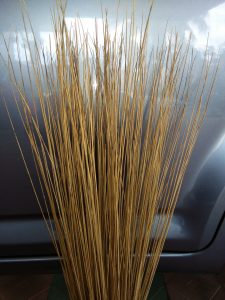
Coconut leaf mid-rib or spine has been used extensively as brooms. However, these brooms have been replaced by plastic brooms, which are cheaper. However, these plastic brooms contribute to the problem of plastic wastes.
Plastic broom, cheap but contributes to plastic waste after useCoconut leaf mid-rib, an environment-friendly broom
Coconut leaf mid-rib brooms are slightly more expensive as they need to be manually separated from the coconut leaves by using a sharp knife, usually done by women in many countries in Southeast Malaysia. The number of the mid-ribs separated is low as these women get tired after a while. They often get hurt by the sharp knife as they tire during the separation process.
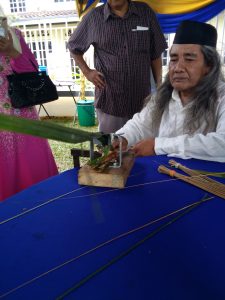
My friend, the “warrior inventor”, Mr Amir Tukiman, had invented a device, which he calls “Lidii”. This device can improve the productivity of separating the spine from the coconut leaf to about 400 per hour. A skilled-person can achieve a rate of above 600 per hour. This device can help a coconut farmer to supplement his income by making coconut mid-rib brooms, which are environmental-friendly.
“Warrior inventor” Mr. Amir Tukiman demonstrating his “Lidii”
The “Lidii” is portable. We are offering early adopters to purchase the device at a price of RM200 or US$20 (FOB) Malaysia. Free delivery is offered to adopters in Klang Valley, Negeri Sembilan and Selangor. Discounts are also offered for order of 5 and more units.
Separation can be done at any location, just requiring a stable table
The “Lidii” can also be used for other palm leaves with firm spines.
Please contact us at 6016 3220 952 or email the inquiry to Dato’ Dr Anuar Md Nor, Founder, Bison Consulting, which is the exclusive agent of the device. His email is datodranuar@gmail.com.
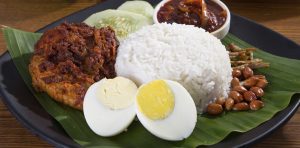
Last week we had lunch at a restaurant in Subang Jaya, near Asia e University. It served rice cooked in coconut milk with a choice of side dishes such as fried chicken and fried egg, which is commonly known as “nasi lemak”. We noted that the restaurant with a seating of about 20 were patronized mainly by non-Muslims. Half of the total seats were empty.
“Nasi lemak” is a popular Malaysian dish for all times of the day
Although potential Muslims patrons were checking the menu placed outside the restaurant but they did not enter. The main reason was that the restaurant did not display a ”Halal” logo at its entrance. The potential Muslim patrons knew that the menu offered by the restaurant did not have pork ingredients, but they would not enter the restaurant because it did not display “Halal” logo on its menu; thus loss revenue for the restaurant.
The restaurant should consider applying “Halal” certification/logo as its “nasi lemak” menu is popular with both non-Muslim and Muslim patrons.
Normally, the application for the “halal” certification/logo could be made directly by a restaurant’s owner. He/she could also appoint a consulting company to assist in the application process. This would usually cost about RM8,000-10,000.
Value of “Halal” Certification/Logo
The restaurant was not attracting Muslim customers as it did not have “Halal” certification/logo. The restaurant would be able to achieve higher patronage from Muslim diners if it had the “Halal” certification/logo.
Let us consider a hypothetical full-service restaurant with 20 seats. In this example, a typical dish with a soft drink is about RM15.00. There are two peak periods; lunch hour and dinner. Presently, during each peak period, we assume that 20 non-Muslim patrons would fill the restaurant (half of seating capacity). Thus, on a daily basis, the revenue of the restaurant is: 20 X 2 XRM15.00=RM600. During each peak period, there would be 20 non-Muslim patrons.
In a year, the annual revenue of the restaurant is RM219,000 (RM600 x 365).
If the restaurant is certified ”Halal” and displays the “Halal” logo, it would attract additional Muslim customers. We assume that the restaurant would now be full during the peak period. The daily taking is now: 40 X 2 xRM15.00=RM1,200.
In a year, the annual revenue of the restaurant is RM438,000.
The value of the “Halal” certification/logo could be estimated as follows:
Industry estimates
Not having “Halal” certification/logo
Having “Halal” certification/logo
Sales
100%
219,000
438,000
Costs of goods sold
30%
65,700
131,400
Payroll and benefits
35%
76,650
153,300
Operating expenses
7%
15,330
30,660
Occupancy expenses
10%
21,900
43,800
General and admin expenses
3%
6,570
13,140
EBITDA
32,850
65,700
Value of “Halal” certification/logo @ 8 per cent capitalization rate
410,625
821,250
Please note, in Malaysia, the “Halal” certification/logo is renewable every two years. Thus, the intangible “Halal” certification/logo has an indefinite life.
Based on this hypothetical restaurant example, the value of the “Halal” certification/logo is the difference between the value of not having and the value of having “Halal” certification/logo, that is RM410,625.
The value is substantial if more restaurant outlets are involved in a country like Malaysia with a predominantly Muslim population.
Conclusion
Having a “Halal” certification/logo would attract both non-Muslim and Muslim customers, thereby improving the revenue of a restaurant. The JAKIM “Halal” certification/logo has been accepted as a benchmark that the ingredients used in the menu of a restaurant are permitted by Islamic principles.
International food franchisers please take note!
Note:
Dato’ Dr Anuar Md Nor is a founder of Bison Consulting, which offers a range of management and technology services, including “Halal” certification/logo. Our website is www.bisonconsulting.net