
Two small companies believe that they are on the verge of a breakthrough that had eluded scientists for decades according to Clive Cookson in an article in Financial Times, dated December 29th, 2019.
This fusion breakthrough would deliver clean and cheap energy by harnessing the nuclear fusion reaction that powers the sun. The two companies use different approaches to generate the fusion reaction.
The failure of sustained attempts to develop fusion power since the 1950’s has not deterred investors from backing scientists at Tokamak Energy and First Light Fusion, two private laboratories based in Oxfordshire, England.
Investors have injected £50 million into Tokamak Energy and £25 million into First Light Fusion. They are seeking to deliver a working reactor ready for commercialization by 2030.
This would be 10 years earlier than the UK Atomic Energy Authority, which runs the state-funded programme. Back in the 1950’s, the UKAEA built the Zeta fusion reactor, which was hailed at the time as a British technological achievement. It closed in 1968 having failed to produce any useful energy.
The UKAEA is working on a new generation of fusion reactors based on the “tokamak” design that originated in the Soviet Union in the 1050’s. This reaction vessel holds the fuel—a plasma of super-heated deuterium and tritium –in place with powerful magnets while raising its temperature above 100mC so that atomic nuclei fuse and release vast amounts of energy.
The UKAEA is working on the design for its next-generation Spherical Tokamak for Energy Production reactor, known as Step, for which the British government has announced £220 million of public investment.
“The Step reactor will be an innovative plan for a commercially-driven fusion power station, offering the realistic prospect of constructing by 2024,” said Ian Chapman, UKAEA chief executive.
The two private companies have even more ambitious schedules.
“We are on course for 100mC, the temperature at which fusion could begin by next March, 2020,“ said David Kingham, executive vice-chairman of Tokamak Energy. Its target is to generate fusion power by 2025 and have a commercial plant by 2030.
First Light Fusion, spun out of Oxford University eight years ago, is pioneering a different approach. Instead of the reactants within a strong magnetic field and super-heating them, it aims to achieve the extreme conditions required to initiate fusion by firing a large number of small copper projectiles simultaneously at hypersonic speed into a tiny capsule containing the deuterium and tritium fuel.
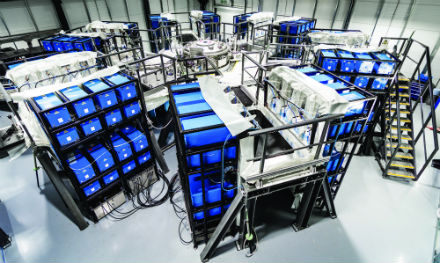
“While magnetic fusion is like a furnace that is always on, our projectile fusion is a pulsed process that transfers energy from each shot into liquid lithium coolant, ” said Nick Hawker, First Light chief executive.
He said the company expected to demonstrate in early 2020 that the system achieves fusion and aim for “gain”, which is when the reactor generates more energy than is used to spark the reaction, by 2024.
“We understand that government labs need to be more cautious in their schedules,” said Mr Kingham. “We envisage having a 150MW device that we can license to people who are good at building power plants.”
First Light is already working with the engineering company Mott MacDonald on a commercial reactor design, with the aim of having a fusion plant powering the grid by the early 2030s. “I am very supportive of the private fusion companies and UKAEA is committed to working with them to help develop their technology,” said Mr Chapman. “The promise of fusion is so huge that there will always be a place for innovation in design.”
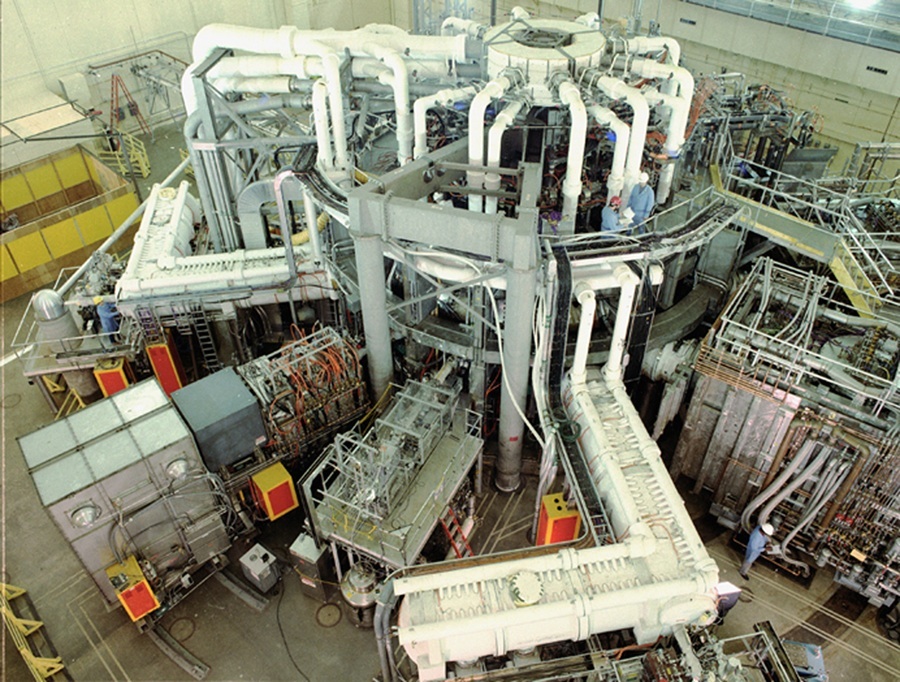
Meanwhile, the UKAEA continues to manage the country’s involvement in big international fusion projects. At Culham, England, it hosts the Joint European Torus or JET, the world’s largest and most powerful tokamak reactor and the focus of the EU’s fusion research programme. JET has been operating since 1983.
A highlight came in 1997 when it was fuelled with a deuterium-tritium reaction mixture and achieved a world record for fusion power of 16 megawatts in 1997, though this was less than the energy put in to heat up the plasma. In recent years, experiments at JET have assisted the design and construction of ITER, a large-scale fusion machine with a reaction vessel 10 metres high (compared with 4.3 metres for JET) which is being built by a global consortium of governments in southern France.
Beset with delays and cost overruns — the current estimate is US$22 billion— ITER is now set to start operating in 2025. The schedule calls for JET to operate at least until 2024, including more runs with deuterium-tritium fuel, though this programme will depend on the UK’s post-Brexit relationship with the EU and Euratom. Although no one knows exactly when commercial fusion power will arrive — and in what form — Mr Chapman expressed total confidence in its eventual arrival. “We will have fusion,” he said, “and Oxfordshire will be closely involved in making it happen.”
Chinese scientists say they have completed construction of a nuclear fusion reactor that will take them on the mammoth pursuit of a virtually unlimited source of power.
The machine, based at the Southwestern Institute of Physics in Chengdu, the capital city of southwest China’s Sichuan province, will become operational in 2020.
China is among several states working on projects to achieve nuclear fusion, the atomic reaction that takes place in the sun and in hydrogen bombs.
The Chinese device consists of a doughnut-shaped chamber called a tokamak, which is similar to the EU-funded Joint European Torus in the UK.
The potential prize is an invaluable contribution to reducing planet-warming emissions. Fusion reactions release no carbon dioxide. Their fuel, derived from water, is abundant.
Experiments in China’s reactor will provide a dress rehearsal for work on ITER.
The Chinese are one of seven main partners – alongside the EU, Japan, Russia, the US, India and South Korea – in ITER, the world’s most expensive international science project, at £15.5 billion.
All partners have agreed to contribute pieces of the reactor, with the central ITER organisation responsible for coordinating construction. The EU owns 45 per cent of the project and the other partners nine per cent each.
ITER promises to produce net fusion power sometime after 2035.