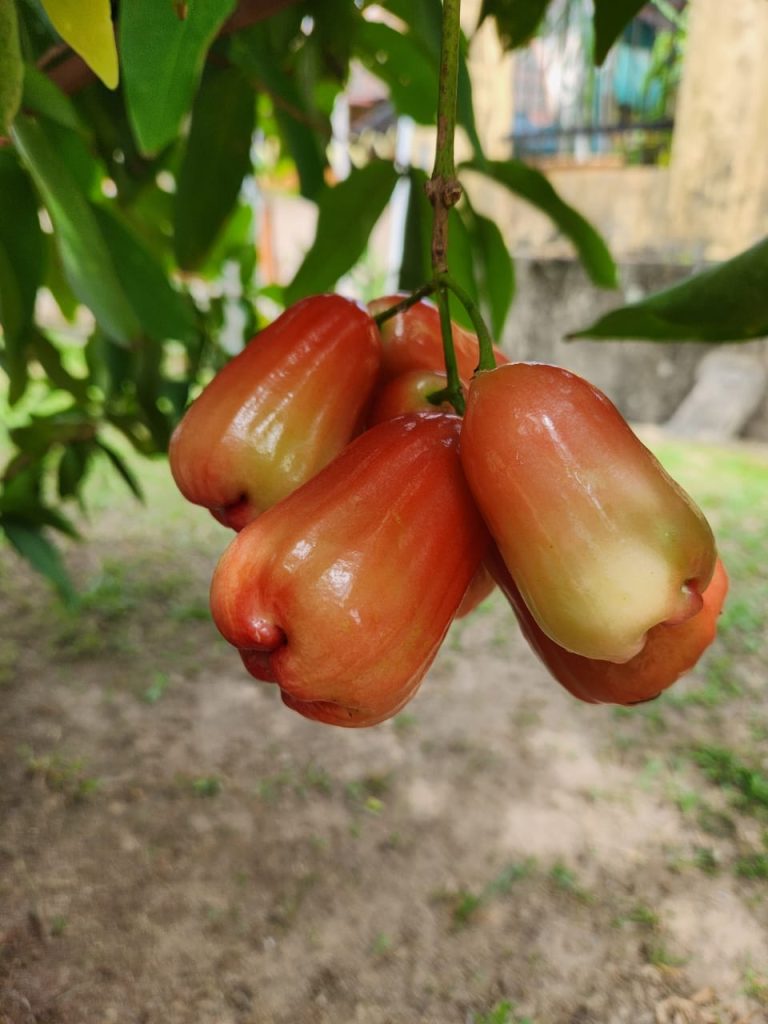
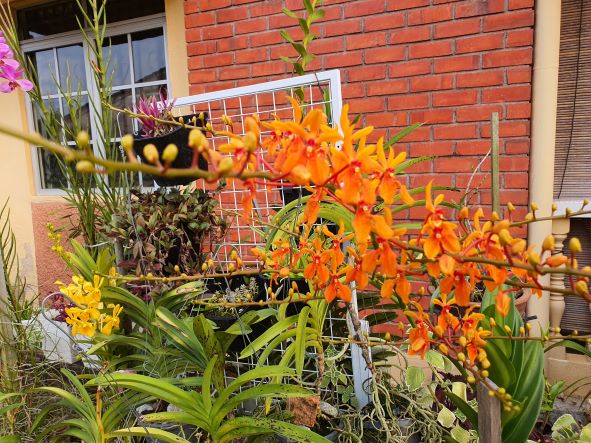
Thanks to my wife, Datin Azimah, who closely takes care of the rose apple tree, pruning and fertlising, we are now ready to enjoy bountiful rose apple fruits. They look juicy red.
The photos are so vivid and beautiful. Readers are welcome to use them in your blogs or albums.
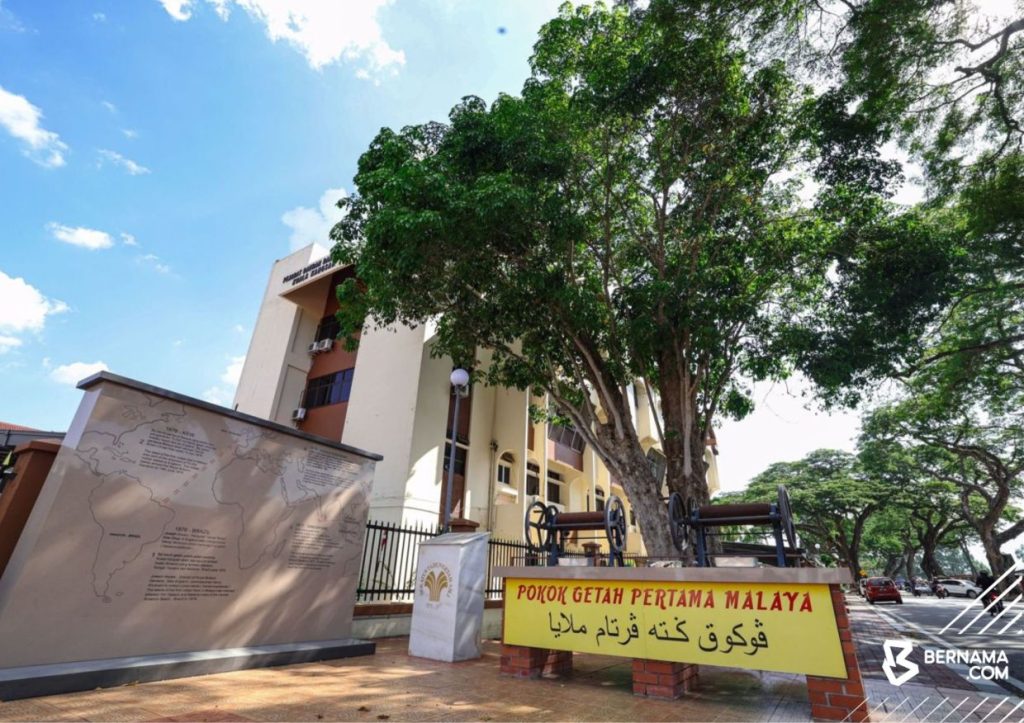
Previously, we highlighted a rubber tree in Kuala Kangsar, Perak, Malaysia. It was the surviving tree among 22 rubber seedlings brought from England.
This rubber tree is 146 years old (Picture sourced from BERNAMA)
In 1877, a total of 22 rubber seedlings were brought into the country from Kew Gardens, England. Of the 22 seedlings, nine were sown in Kuala Kangsar. This is the only surviving tree.
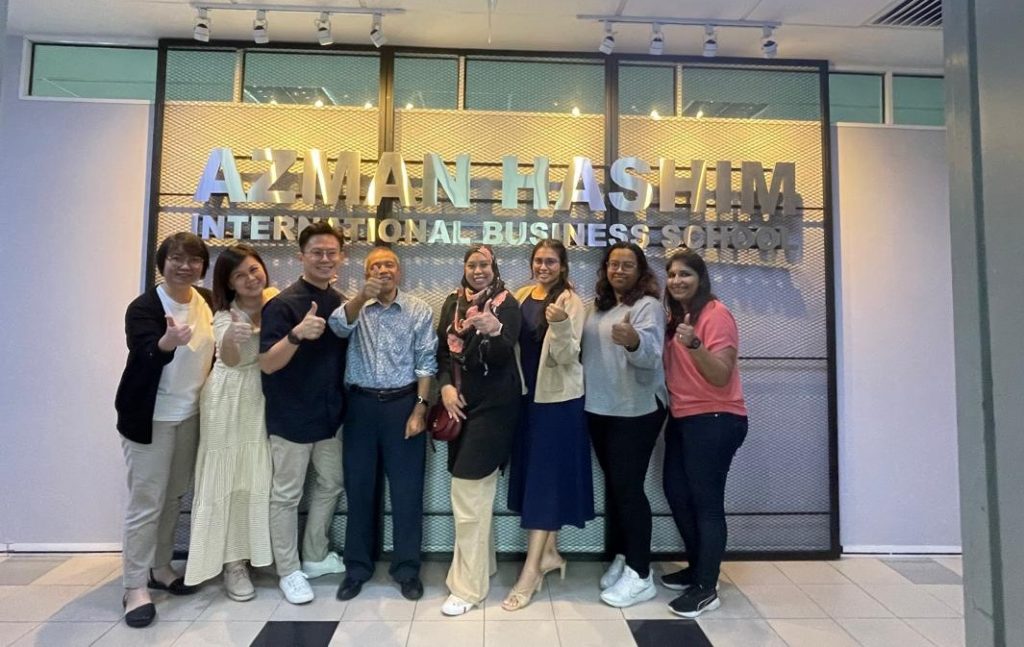
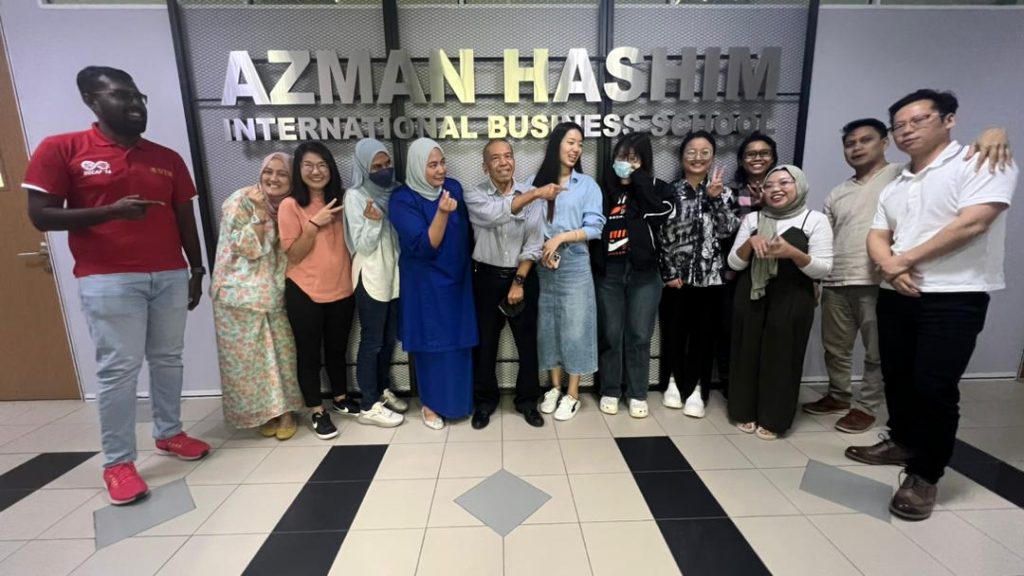
I wish to thank the Azman Hashim International Business School at UTM, Malaysia MBA students in change management, Semester 2 June 2023 for sharing your comments and experiences in class.
I hope all of you will strive hard and succeed to be CEOs of companies in future.
From left. Alshammari, Lin Hao, Maria, Dr Liyana, Dato’ Dr Anuar, Sukmawati, Mathini, Xu Xiang, and Xu Yidan. Not in the picture: Putri and Shaiswary
The growing sobriety of Japan’s young people is hitting the amount of revenue flowing into state coffers and has inspired the national tax agency to run a competition for ideas to encourage more drinking.
Tax raised from alcohol sales accounted for 5 per cent of total government revenue in 1980, dropping to 3 per cent by 2011 and less than 2 per cent by 2020.
While alcohol taxes still raised US$80 billion in 2020, Japan’s national debt to GDP ratio, at about 240 per cent, is worse than any country in the world except Zimbabwe’s. The government can ill-afford to lose more tax revenue.
Average alcohol consumption fell from 100 litres per capita in 1995 to 75 litres in 2020, much of that drop caused by drinking falling out of favour with a younger generation. Whereas junior employees were once expected to routinely accompany their seniors and bosses on boozy nights out after work, these days many young salarymen and women refuse to participate in such revelry or are completely teetotal. The pandemic has exacerbated the situation, as many Japanese fell out of the habit of going for drinks with friends. The tax agency campaign is looking for ideas to revitalise drinking culture, including those who choose to consume at home.
With its first round running until September 9, the Sake Viva! campaign is looking for ideas, which could include the promotion of imbibing using artificial intelligence and the metaverse. According to the campaign website: “The aim of this project is to appeal to the younger generation regarding the development and promotion of Japanese alcoholic beverages by having young people themselves propose business ideas, and to revitalise the industry by promoting great plans.”
Selected entries will progress to a final stage and an award ceremony for winners will be held in Tokyo on November 10. The winning ideas will be used by the tax agency for commercial campaigns.
Reactions to the campaign from the public have been mixed, with many online comments questioning the wisdom of a government encouraging its citizens to drink more alcohol.
Japan’s health ministry issued a statement saying it hoped the campaign would recommend that people drink alcohol in moderation.
Overseas applicants can enter the contest, as long as they submit materials and make presentations in Japanese.
Alcoholic beverage market in Japan
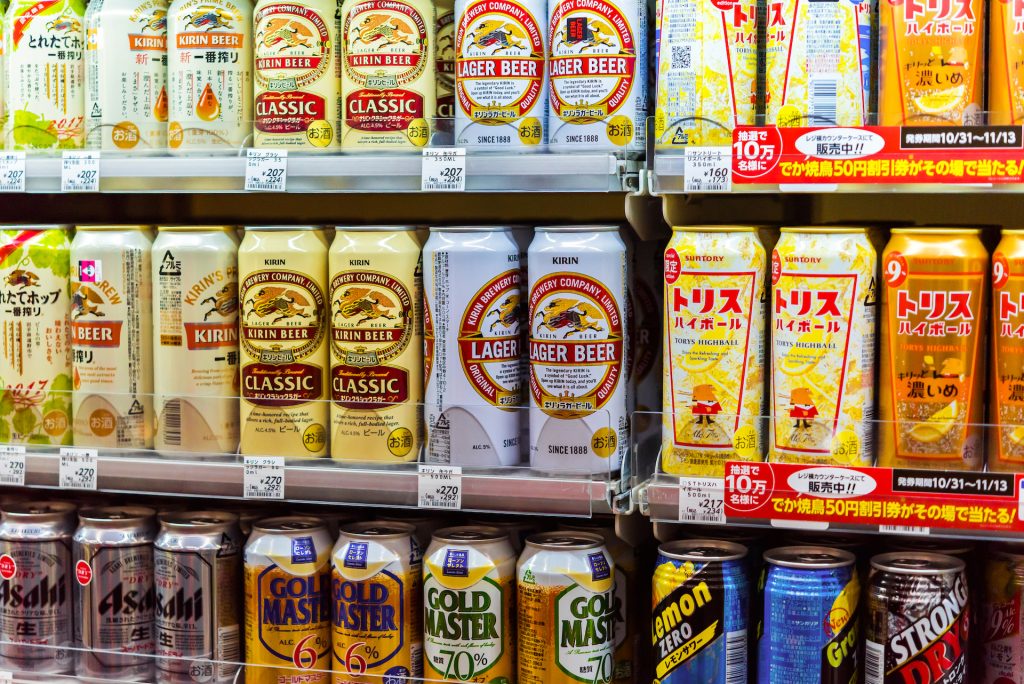
The market size of alcoholic beverage in Japan is about US$35 billion, according to the report of Japan’s National Tax Administration Agency. However, the market is shrinking little by little every year. The consumption amount of alcoholic drink also fell to about half of that in its prime. The number of people who drink in a bar or restaurant was decreasing during the years. On the other hand, the number of people who drink in a house was increasing.
According to consumption amount of types of alcoholic beverages, a beer is the most popular alcoholic beverage in Japan. However, the ratio of beer is decreasing every year. The ratio of liqueur and wine are increasing instead of beer. It is said many young Japanese people don’t like the bitter taste of beer.
There are three types of beers, which consist of normal beer, low-malt beer and the third beer in Japan. The amount of liquor tax of Japan increases by the amount of malt, so beer companies make low-malt beer called Happoshu to keep down the tax and sell it cheaper than normal beer. As a result, Japanese government raised liquor tax for low-malt beer because of fearing decreasing amount of liquor tax.
Beer companies made the third beer in response to rising liquor tax. The third beer has a taste similar to beer without malt. It belongs to the category of a liqueur in Japanese tax law because if does not have a malt, so the third beer is sold at a lower price than low-malt beer. It contributes to increasing liqueur consumption. Thus, the third beer has become the cheapest beer.
It seems beer companies in Japan can find ways around taxation to offer the cheapest alcoholic beverage to Japanese consumers.
We should note that tax on alcoholic drinks are steep in most countries as a way of raising tax receipts for governments.
Good luck to Japanese government in your increased beer consumption campaigns!
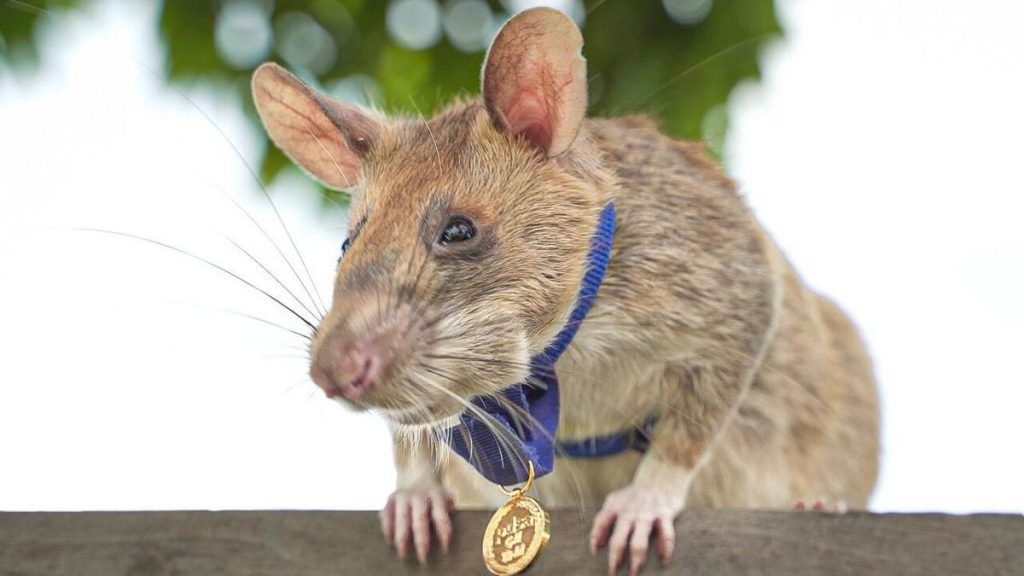
Previously, we covered about Magawa, the landmine detector that was awarded a gold medal for heroism for clearing ordnance from the Cambodian countryside. Magawa has just died.
Magawa, a giant African pouched rat originally from Tanzania, helped clear mines from about 225,000 square metres of land – the equivalent of 42 football pitches – over the course of his career.
After detecting more than 100 landmines and other explosives, Magawa retired in June last year.
Magawa passed away “peacefully” this weekend at the age of eight, said the Belgian charity Apopo, which trained him.
“All of us at Apopo are feeling the loss of Magawa and we are grateful for the incredible work he’s done,” the group said.
Apopo said Magawa was in good health and spent most of last week playing with his usual enthusiasm.
But towards the weekend “he started to slow down, napping more and showing less interest in food in his last days”, the charity said.
Apopo trained Magawa to detect the chemical compounds in explosives by rewarding him with tasty treats – his favourites being bananas and peanuts.
He would alert deminers by scratching the earth after using “his amazing sense of smell”.
Magawa was able to cover an area the size of a tennis court in 30 minutes, something that would take four days using a conventional metal detector.
In September 2020, the rodent won the animal equivalent of Britain’s highest civilian honour for bravery because of his uncanny knack for uncovering landmines and unexploded ordnance.
Magawa was the first rat to receive a medal from British veterinary charity PDSA in the 77 years of the awards, joining an illustrious band of brave canines, felines – and even a pigeon.
Millions of landmines were laid in Cambodia during the country’s nearly three-decade civil war which ended in 1998, causing tens of thousands of casualties.
Three Cambodian deminers were killed on Monday by anti-tank landmines that exploded as they tried to remove them, just 20 minutes after a man burning vegetation on his farm was killed by war-era ordnance in the same village.
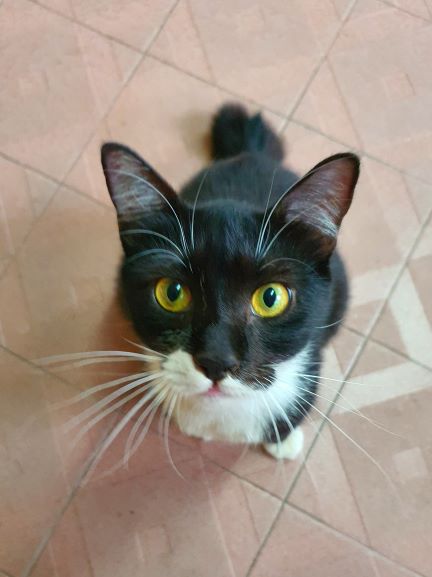
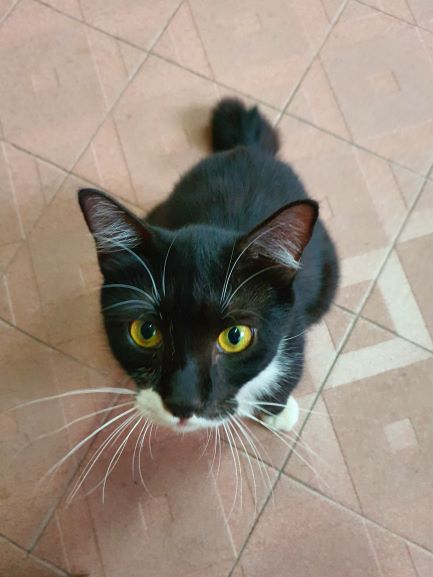
My youngest cat, Salina Boy, is growing fast. He has become a big bully to the other cats, Baby, Yen, Charlie and Tuya. I manage to capture two poses from Salina Boy.
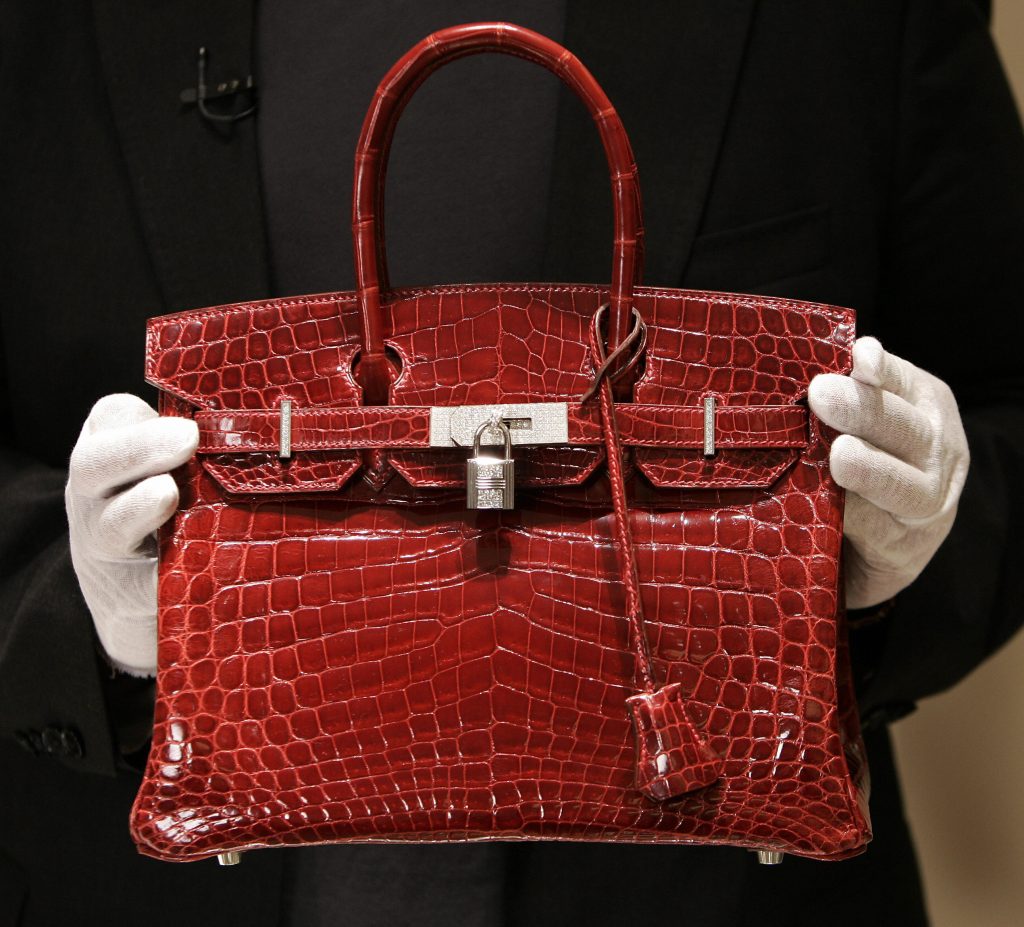
A Birkin handbag is the most expensive handbag for collection
An article in the London Sunday Times on February 28th, 2021, was an interesting one.
It quoted Hermes handbags, made by the French company, Hermes International SA, went up by 17 per cent in price while the FTSE 100 index fell by 14.3 per cent. Aside from being a highly desirable fashion accessories, luxury handbags are becoming an investment class of their own rights.
It was the second year in a row that bags outstripped other luxury goods in an index including classic cars, coloured diamonds, watches, jewellery and wine.
In 2019 handbags increased 13 per cent and over ten years they went up by 108 per cent in value, according to the estate agency, Knight Frank.
Hermes bags start at £1,418, and the label’s Birkin bag range usually begins at £6,370. A rare Hermes Himalaya Kelly bag made of crocodile hide became the most expensive handbag sold at an auction when it was bought at a Christie’s sale in Hong Kong for US$437,330 (£309,561) in November 2020.
According to the website, cnaluxury.channelnewsasia.com, it is possible to create an index on handbags now because of the frequency which many iconic pieces are coming to auction today. Although bags made by other luxury brands like Chanel and Louis Vuitton are also highly collectible, it is those made by Hermes that attract the highest prices and are considered the most desirable. Chanel is the second most popular handmade for collection.
The rise in value of handbags is also a result of brands increasing their prices every year, culminating in an increase in value in the pre-loved market. Hermes bags are the most difficult to get hold of, so they are the most coveted of all.
According to Knight Frank luxury investment index, fine wine went up 13 per cent last year and 127 per cent over a decade, bolstered by older Tuscan wines which increased by 8 per cent and champagne, which went up 14 per cent.
Art values fell 11 per cent on average because of the collapse in public auctions, and coloured diamonds fell 1 per cent because of the difficulty of transporting diamonds in the pandemic.
The conclusion of the article is obvious: Investing in a Hermes bag, especially a Birkin, will give a good return. Most important, it will also please your wife enormously. The caveat is that whether you can afford it.