
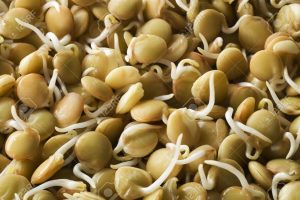
Eat more Soybean Sprouts

Introduction

A sprouting soybean contains beneficial bioactives

Our new consulting assignment involves an interesting legume.  Our client has been involved in the research and development of functional ingredients. The key functional ingredients that it is focusing on are those that could be derived from soybean (Glycine max).

Soybean is an important crop that began many thousand years ago. In recent years soybean has been gaining attention since it is considered a functional food. Its consumption has been linked to the prevention of cancer, type 2 diabetes, cardiovascular and gastrointestinal diseases, cholesterol reduction, and obesity

The main components responsible for the protection of health are the bioactive compounds such as peptides, lunasin, lectins, Bowman-Birk inhibitors, isoflavones, saponins and others.

As a rich source of protein for food and animal feed, soybean is the most protein-rich plant when compared to other cereals or legumes.  Soy protein has high nutritive value. The main components are the storage proteins known as β-conglycinin and glycinin, which represents around 50-85% of the total protein of the grain. Other minor proteins and glycoproteins include lipoxygenases, lections, trypsin inhibitors and α-amylases. As minor components, soybean contain vitamins such as thiamine, riboflavin and vitamin E as well as several bioactive compounds such as isflavones, saponins, phytates, phytosterols, trypsin inhibitors, lectin, and lunasin Bowman Birk inhibitor.

In 1999, the Food and Drug Administration of the USA has issued a document to formalize the therapeutic potential of soybean in preventing heart disease.

 The Problem of Diabetes

Diabetes occurs when there are raised levels of glucose in the blood because the body cannot produce any or enough of the hormone, insulin, or use insulin effectively.

Diabetes is a major human disease. According to International Diabetic Federation (IDF), in 2017 there were 425 million people in the world had diabetic condition, an increase from 151 million in 2000. Most of the diabetic sufferers are in developing countries who could not afford expensive treatment using conventional drugs.  It is estimated that the total healthcare expenditure by people with diabetes was US$727 billion in 2017.

Many governments in large developing countries, such as China, India and Indonesia,  are encouraging research on bioactive compounds that could be found in plants, herbs  and grains that could treat diabetes. Many of these plants have been used in traditional medicines to treat diabetes. Diabetic patients usually experience lower-quality life due to complications from using current conventional drugs.

Our client has been researching on the bioactive compounds in plants, herbs and grain that could treat and manage health of diabetic patients. Based on literature review and attending conferences in India, the client identified and contacted scientists who are conducting research on these bioactive compounds to treat diabetes. It also funded several research activities using diabetic-induced wistar mice. The client had identified a new compound that it has isolated and investigated that has the potential to treat diabetes from germinated bean sprouts.

Germinated Soybean Sprouts  

Extensive literature reviews show that germination process provides increased nutritional value, by improving the digestibility and increasing the amount of protein efficiency ratio, reducing anti-nutritional factors in legumes, such as protolytic inhibitors and lections, causing hydrolysis of oligosaccacharides (raffinose and stachynoese) present in soybeans, which cause flatulence.

Although germination is a complex phenomenon, it can be characterized when under appropriate conditions the embryo axis of the seed continues its development, which is interrupted by physiological maturity. A seed will germinate when certain conditions are favourable, such as adequate water supply, suitable temperature, composition of gases in the atmosphere, light (some seeds) and absence of germination inhibitors. The first two conditions are the most critical factors.

The direct use of soybeans in human foods has been limited by the presence of several anti-nutritional factors. The majority of processed soybean products have been derived from dry mature soybeans. However, the development of products from germinated soybean presents another option to increase the versatility and utilization of soybeans. In addition, germination has been identified as an inexpensive and effective technology for improving the antithrombotic, anti-inflammatory, anti-oxidative and anti-obesity activities.

The Process of Germination    

Germination is a feasible and low-cost process that allows the decrease of non-nutritional compounds as well as the increase of bioactive compounds of some legumes. During this process, a series of cellular events take place to facilitate the growth of the embryo.

Germination has three phases:

  1. Phase 1: hydration. The tissues of the seed absorb the highest possible amount of water, and the respiration rate and volume of the seed increase.
  2. Phase 2: germination. Under this phase, there is a transformation of metabolites necessary for the development of the seedling takes place, the absorption of water is reduced, respiration and synthesis of new compounds increase, allowing cellular expansion and division, until the embryonic axis begins to express. During this stage, the storage nutrients (protein, lipids and carbohydrates) are mobilized in order to provide the necessary energy for protein synthesis and growth of the seedlings.
  3. Phase 3: growth. It is related to the emergence of the radicle. In this stage, digestive enzymes are activated and the proteins are hydrolysed to amino acids, which act as precursors for the synthesis of new proteins or other nitrogen-containing compounds.

As germination mobilizes the nutrients required for the development of the seedling, it removes some non-nutritional factors such as phytates, oligosaccharides, tannins and protease inhibitors.    .

Conclusion

Our client plans to undertake more research on the new bioactive compound identified in soybean sprouts for treating diabetes.
The More Bizarre Food: Porcupine Bezoar

Introduction 

We are a keen follower of the host of The Bizarre Food, Mr. Andrew Zimmern. He eats all kinds of bizarre food. In the many episodes, we had not watched him eat a most bizarre food, namely porcupine bezoar.

Porcupine bezoar is a very expensive herbal food in traditional Chinese medicine. The Chinese believe that porcupine bezoar can treat various kinds of cancer if you can afford it. In Malaysia, a gramme of porcupine bezoar costs about RM 700 (US$/RM exchange rate is 1=3.9). This is despite little scientific research evidence to confirm its effectiveness.

Porcupine Bezoar

Porcupine belongs to the herbivores group of animals. In Indonesia and Malaysia, they feed on bitter-tasting roots and branches of plants and herbs. The diet of porcupine is associated to its strong immune system and ability to self-heal quickly. Porcupine is considered to possess strong immune system that effectively fights toxins and inhibits the effects of poison from its diets.

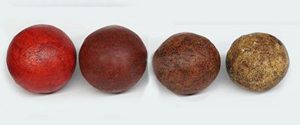
Bezoar means antidote in Persian language. It is explained that the herbs that porcupine eats when it is sick contain chemical compounds that help fight the damages caused by toxins as well as facilitate healing. The used-chemical compounds from herbs ingested by porcupine form a stone-like-substance inside its body, which is called bezoar. The Chinese takes porcupine bezoar to treat diabetes, hepatitis and dengue fever. It is also taken by cancer patients. The porcupine bezoar stone is formed in the bodies of porcupine is composed of several layers that it looks like an onion. The various grades of porcupine bezoar are shown in Picture 1.


Grades of Porcupine Bezoar: Pink Colour is Expensive

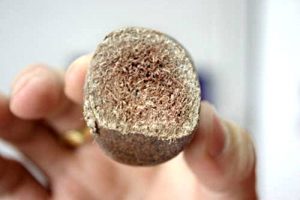
Picture 2 shows the cross section of a porcupine bezoar.

                         Inside of Porcupine Bezoar
Presently, the porcupine bezoar is harvested from porcupine caught in the wild, mainly in Indonesia. Typically, a porcupine bezoar weighs less than 100 grammes. A rare porcupine bezoar weighing 100 grammes can be sold for RM115,000.

High Demands Threaten Porcupine’s Population   

The high demand for porcupine bezoar in the traditional Chinese medicine market has reduced the population of porcupines in the wild in Malaysia and Indonesia. Porcupine population in Indonesia is now restricted to remote areas only. It is noted that a porcupine bezoar is found in about 1 in ten porcupines. In order to harvest the porcupine bezoar, the porcupine is killed and the body is disposed. The Chinese also believes the meat of porcupine has medicinal value.

There is a need to develop a sustainable practice of harvesting porcupine bezoar through modern breeding technique and recovery of porcupine bezoar. In the wild, the porcupine bezoar is valuable because the porcupine eats selected herbs that contain bioactive ingredients which accumulate in the porcupine bezoar.

It is necessary to use modern surgery to recover porcupine bezoar from the stomach of the porcopine without killing it. There is also a need to understand under what conditions and circumstances that a porcupine develops a bezoar in its stomach. This may increase the rate of porcupine bezoar that could be harvested in a population.

The high demand for porcupine bezoar is also leading to the trading of fake porcupine bezoar. According to reports in Malaysian Chinese newspapers, many victims bought porcupine bezoar which comprised balls of herbal leaves that look like a porcupine bezoar. Thus, there is a need to develop a system of quality control to ensure a genuine porcupine bezoar is only sold in the market.

We are consulting a Malaysian company which intends to develop a sustainable method to breed porcupines to harvest porcupine bezoar. The key to the success of the project is to identify herbs that are taken by porcupine in the wild that give the unique potency of the porcupine bezoar.

Webelieve when one has cancer, a ball of uneaten herbs in the stomach of a porcupine is not very bizarre after all.

Interlude: Technologies Developed by Malaysian Innovators

Last Thursday, we had the opportunity to review new technologies developed and shown at the Malaysian Technology Expo (MTE) 2018.

Those who are interested to know more on the technologies, please get in touch with me.

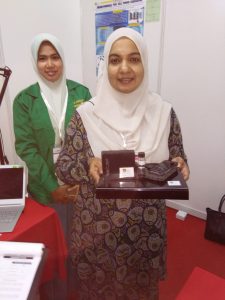
Prof. Ir. Dr Dr Siti Kartom Had Developed a Power Bank Using Fuel Cell Technology

This power bank, which uses fuel  cell technology, is very useful in areas where there is no source of electricity supply.


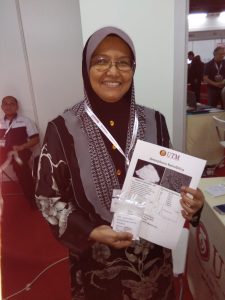
Prof. Dr. Noriah Had Developed Technology to Convert Waste Rice Husk into Amorphous Silica Using Laser

The technology she had developed is using laser to convert waste rice husk into amorphous silica. As the waste rice husk is completely converted, there is no residue in the process.

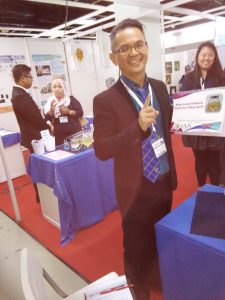
Assoc. Prof. Dr. Coswald Had Developed Formulation for Long-Lasting Denim Colour

The formulation is a dye that allows long-lasting blue colour of a denim.

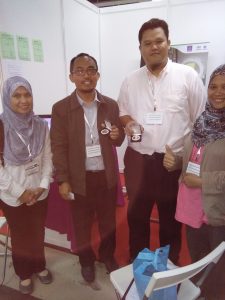
A Team from National Metrology Institute of Malaysia Had Developed a Standard to Verify Gold Purity

The technology involved a standard gold block to verify density and purity that can be used to detect fake gold.

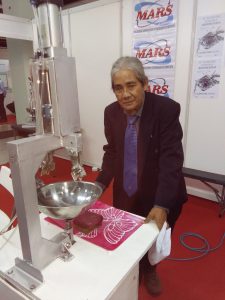
My Friend, Mr. Amir, a Fecund Inventor with His invention of Durian Opener


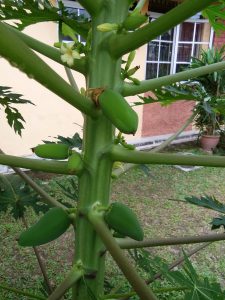
Several Fruits Growing Nicely.

Lastly, my papaya is growing nicely, having reached a size of 6-cm long since January 24th, 2018.


How Did Malaysia Excel in Palm Oil Industry?

The Previous Rubber Industry

The car industry in the early 1900s spurred the establishment of vast rubber plantations in Malaysia (Malaya then). Rubber companies with names of British towns were floated on the London Stock Exchange to fund the planting of rubber trees. Till the 1960s, rubber exports were the main source of revenue for the country. Smoked rubber sheets were sold by large British-owned companies to manufacturers in Britain, Germany and the US to produce a variety of rubber products, such as tires and conveyor belts. A city in Ohio, US, Akron, became the main beneficiary of the major demand for tires. It was called the “rubber capital of the world” until the 1950s, where large tire manufacturers established factories in Akron to supply booming car companies in Detroit, Michigan.

Today, Akron is no longer a rubber bustling city. The city is now encouraging new companies that could develop new products based on the knowledge of the rubber technology.

Throughout the period, Malaysia remained as the largest exporter of smoked rubber sheets. In the 1970s and 1980s the Malaysian government encouraged local firms to establish tire manufacturing plants to supply both local and export markets. As tires are bulky products, they need to be closed to car companies. As Malaysia did not have a large car industry, these tire companies are mainly servicing the local car companies as well as for the replacement market.  Thus, Malaysia did not take advantage of its rubber to establish a rubber product industry. One bright spot is that Malaysia has managed to become the largest exporter of rubber latex gloves, albeit most of the rubber latex comes from Thailand.

A Different Path for the Palm Oil Industry

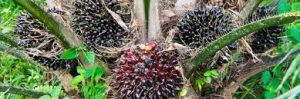
Palm Oil Tree with Maturing Fruit Bunches

Unlike the rubber industry, Malaysia had succeeded in taking advantage of its palm oil resource. We have conducted a PhD-level research on the key factors that allow the palm oil industry to innovate, from the planting of oil palm trees to the processing and development of new products for food and industrial applications. Various products were derived from palm oil such as substitute for chocolate, and washing powders. If we analyse the list of ingredients in our favourite consumer products, such as KitKat and Nutella, we will note that they contain at least one or two ingredients from palm oil. These ingredients are manufactured by large Malaysian palm oil multinationals, which have operations in many countries (See our book, The Palm Oil Multinationals from Malaysia: How they control a global Industry that started from four humble seeds. It is available from Amazon.com.)

Popular Consumer Products Containing Palm Oil Ingredients

The Presence of Institutional Networks for Knowledge Generation, Sharing and Adoption in Palm Oil Industry 

The study had identified a close network that facilitates knowledge generation, knowledge sharing and knowledge absorption in the Malaysian palm industry. The close network was formed as a result of historical contexts and on-going interactions promoted by focal institutions with responsibilities to develop the palm oil industry. This close network, which we term the palm oil institutional network, links an industry-funded R&D institute with palm oil firms, governmental institutions, industry associations and groups of technical and scientific experts. The inputs from on-going and close interactions are utilized by the industry-funded R&D institute to develop its R&D programmes, especially medium- and long-term R&D efforts, which are avoided by commercial interests of palm oil firms.

Five types of network, which collectively create the palm oil institutional network, are; (1) government-mandated technological networks, (2) industry associational network, (3) institutional policy network, (4) government-linked corporate networks, and (5) expert informational networks.

The government-mandated technological networks (GTN) were formed by government legislation to formulate and undertake R&D activities for the palm oil industry. The main components of the GTN are a government R&D institute, the Malaysian Palm Oil Board (The MPOB), important industry associations, major palm oil firms, and technical expert communities. The MPOB is funded through a collection of levies paid by palm oil firms. The MPOB formulates its research activities through inputs obtained from industry associations, technical expert communities and members of industry associations on board of the research institute.

The MPOB is a Global Leader in R&D Activities of Palm Oil

The MPOB actively shares its R&D findings with palm oil firms through technology bulletins, conferences, workshops and technology licensing. It is the main generator of new knowledge for the palm oil industry over the last thirty years. This new knowledge is widely discussed among palm oil firms. As example was that the discovery of an African weevil for the pollination of oil palm by a private palm oil was quickly adopted by other palm oil firms, thereby increasing the overall productivity of the palm oil industry.

The industry associations are the earliest business networks in the palm oil industry. Initially these industry associations acted as social organizations for members and planters. As the palm oil industry expanded, these associations were invited by government to be involved in policy-making committees. These industry associations are a key component in the dissemination of information among its members. An important industry association is the Incorporated Society of Planters (ISP), whose members are managers of the plantation industry. The ISP helps, formally and informally, in the sharing of industry best-practices over many decades since its incorporation in 1919.

The industry associations help to create institutional routines, which are represented by regular interactions among various institutions. Firms in the palm oil industry are involved in guiding the direction of the palm oil industry through industry associations.

Institutional policy networks are linkages used by governmental units to formulate policies affecting the palm oil industry. The main objectives if the governmental policies had been to facilitate the business environment for the palm oil industry. The institutional policy network links public institutions with palm oil firms and industry associations for exchanging information, expertise, trust and other political resources.

Many governmental ministries are involved in institutional policy networks within the palm oil industry. Industry associations are involved in discussions, annual industry dialogues and sit on various governmental committees for inputs on policy-making. Common industry problems are regularly discussed and a united stance is arrived at to address these common industry problems.

Government-linked corporate networks are linkages among firms in which the government has significant direct ownership. These government-owned firms are often provided with incentives to undertake projects or activities that can strengthen the palm oil industry through technology acquisition and infrastructure development. Moreover, government-linked palm oil firms own substantial acreage of plantation lands

Government-owned companies, which are large palm oil firms, are instrumental in the generation and sharing of knowledge, with collaboration being an important R&D strategy.

Our research shows the long-term nature of research for a crop like oil palm requires palm oil firms to collaborate with other firms and governmental institutions to reduce costs and risks. As an example, the research to develop a new high-yielding oil palm can take over thirty years before a successful variety is commercialized for planting. Thus, the nature of the oil palm research provides strong motivation to collaborate, which leads to a permanent need of an institutional network.

The palm oil institutional network is supported by an informal personal network, which has been nurtured through a long history of social interactions and personnel transfers between companies. This informal societies and communities within the palm oil industry form a strong informal network for knowledge sharing.

The expert informational network (EIN) is a new type of network which is formally used by the Malaysian palm oil industry to search for new information and planning R&D activities. The EIN is set-up by the MPOB since its establishment thirty years ago, by the appointment well-known local and foreign experts to sit on a number of technical committees, named Programme Advisory Committees (PACs). The formal EIN allows the MPOB to consider independent inputs to plan its R&D activities as well seeking inputs of palm oil firms. As at April 2013, the PAC had sixty four members of experts from industry and academia.

 Conclusion

Despite the African origin of oil palm, Malaysia first developed the palm oil industry from a small base to become the leading producer through technology accumulation processes. In order to generate new knowledge, the government established new institutions to undertake industry research and commercialize new technologies to benefit the palm oil industry. A tax was imposed on palm oil firms to fund the operation of an industry-focused R&D institute, and, in return, the palm oil firms are involved in guiding the direction of the R&D activities of the MPOB. The inputs for its R&D activities are drawn and refined through continuous and close interactions between palm oil firms, the MPOB, industry associations, governmental units and industry experts. The results of the R&D findings are disseminated in various codified and non-codified knowledge through various mechanisms. The MPOB also taps the knowledge of a global network of experts to search for new information and technology directions, which we call expert informational network (EIN), and is unique to the Malaysian palm oil industry for generation of new knowledge. These formal institutional relationships are reinforced by informal linkages among institutions and individuals in the Malaysian palm oil industry, which norms of relationships have been propagated by generations of industry executives, industry leaders and institutional heads.


The Sweet Spot of Online Travel Agents

               Websites of the Expedia Group

Introduction

My hard-working wife uses only a specific brand of toothpaste, Colgate. She has been long exposed to the advertisements of the toothpaste since she was small. These days, to a Malaysian child of 5-years old and above, nice foods mean McDonald’s, snacks mean Shell petrol stations and holidays means Tivago.

In fact, my wife told me that a 5-year old granddaughter of her friend already equates Tivago with  holidays when the advertisement of Tivago appears on television.

Tivago is a well-known online travel agent. What is the business model of online travel agent? What is the sweet spot of online travel agent?

Tivago and other online travel agents have become the main channel to book hotels worldwide. In return, hotels secure room bookings and improve their occupancy rates. Less well-known hotels and lodgings also use online travel agents to market their facilities to consumers worldwide. The power of online agents is disliked by major hotel groups, as by using online travel agents they forgo a considerable income through paying commission fees to online travel agents.

At the same time, these hotels would lose market share to other hotels that work with online travel agents. As hotel rooms are perishable goods and cannot be reserved for future use, hotels must make a trade-off between potentially higher revenue from selling their rooms by themselves or lower revenue by selling the rooms by online travel agents.

The Business Model of Online Travel Agents

The online travel agent practices a number of business models , which are as follows:

  1. The merchant model,
  2. Hotel collect/Agency model,
  3. Flexible/Opaque model

The Merchant Model

The merchant model involves the online travel agent purchasing a given quantity of rooms from a hotel at a wholesale price or rate. Then, the online travel agent will mark-up the price and offer the rooms to their online customers. Under the merchant model, the online travel agent bears the risk of unsold rooms.

Extensive use of online travel agents under the merchant model has resulted in erosion of unified pricing plans that are favoured by major hotel groups.

The Hotel Collect/Agency Model

The hotel collect/Agency model involves the online travel agent agreeing to distribute the rooms at an agreed-price with the hotels. The online travel agent receives a commission on each of the room when the guest leaves.

Flexible/Opaque Model

Under the flexible/opaque model, the online travel agent distributes rooms at an agreed price set by the hotel. Then, the online travel agent matches the bids of customers with the lowest price offered by the hotels. The online travel agent makes a profit through the price difference once the hotels accept the transactions. In the opaque model, customers purchase rooms on the online travel agent’s website without knowing the hotel brand before they make payment.

The three business models used by online travel agents involve having information about the buyers of rooms that is not available to the sellers of rooms and information about the sellers that the buyers of rooms do not know.

The Online Travel Agent Industry

The online travel agency is made-up of only a few firms. Although there are frequently new entrants, they tend to be gobbled-up by existing firms. The major companies own many different websites, some of which offer different services. Most of the websites function as metasearch engines that pull prices and offerings from their own networks. The term metasearch is used, since each provider’s website is  a search engine that shows listing from only that company across times location, or services.

Revenue Streams

Revenues of travel online agents are derived from three main sources.

The first revenue is agency revenue where the online travel agent’s website is simply an intermediary that connects a customer with a provider of travel services. The costs of transactions are not borne by the online travel agent. There would be no costs of revenue and costs of goods sold associated with these transactions.

The second revenue is merchant’s revenue where the online travel agent is the merchant of record, and costs associated with the transactions are borne by the online travel agents. These costs include credit card processing fees, costs associated with securing a package or deal and any other fees that might be associated with the transactions.

The third revenue is from advertising. Advertising does not have associated costs since the advertisements are displayed on company-owned websites.

Conclusion

Websites of Priceline Group

The online travel agent industry is one of intermediaries that is insulated from and tends to benefit from the intense competition among travel service providers like hotels and airlines. It is also at a stage of consolidation that direct competitors tend to be swallowed up. The cost of entering the industry Is low, simply requiring a website infrastructure and a search algorithms. New entrants that curve out a customer base are acquired, but the websites brand is usually maintained.

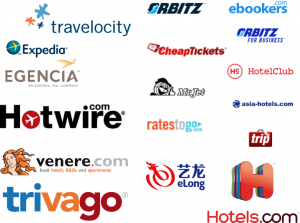
Many of the well-known websites are owned by Priceline or Expedia, as shown below:

Firm Websites
Priceline Booking.com

Priceline.com

Agoda.com

KAYAK

Rentalcars.com

OpenTable

Tivago.com

Expedia Expedia.com

Hotels.com

Travelocity

Egencia.com

Carrentals.com

Orbitz.com

Cheaptickets.com

Tripadvisor Tripadvisor.com
Ctrip Ctrip.com


The travel online agent industry is enjoying a sweet spot and this is driven by the wealthy consumers in China, Japan, Europe, US and emerging countries who want to enjoy travel experiences.

Reference:

  1. The Henry Fund, February 10th, 2016. Online travel agencies
  2. Paper submitted by my DBA students, Rajiv Mangruwa and Rosalind Sinnappan

Interlude: Work, Technology and Organization, Class September 2017

                                    Congratulation to All DBA Students

Dr Haji , virtual network expert and Dr Gina,  over-educated insurance agent

A hard working pair

Dr Rajiv and Me

Internet travel expert from Indonesia

Dr Eliana, Dr Khalfan and Dr Ammar

Eliana and two handsome guys from Middle East

Dr Anak, Dr Major, Dr Mohd Mazlan and  Dr Mohammad Shahril

 A clever group with great future ahead of them 

Dr Haji, Dr Gina, Dr Rosalind and Dr Rajiv

The lady’s man with his class mates

Not in the pictures are Dr Barraa, Dr Daniel and Dr Shazleena

Well-known Department Stores Fight Back Online Competitors

Introduction

Previously, locals and foreign tourists to London and New York would head to Harrods, Barneys, Bloomingdale’s when they were in town. Lately, lesser number of tourists is shopping at these grand department stores as they have been buying luxury handbags and cloths online.

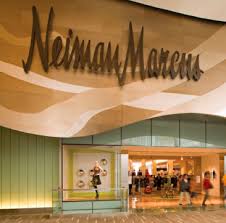
A Neiman Marcus’s Department Store

The grand department stores are fighting back with an array of initiatives to draw customers in and engage them longer, according to an article in Financial Times, How to Spent  It, published on October 7th, 2017.

They have been troubling times for department stores in London and Manhattan, New York, where competition from internet shopping is merely one of the challenges facing the grand old department stores. In their heyday they and their global counterparts encapsulated the spirit of their age, but that age is no more. What is left are vats edifices, which if they are to survive, have to reinvent themselves for the new times we are lining in and keep on their toes as their customers’ tastes and habits continue to evolve.

As Trevor Hardy, CEO of trend-forecasting agency The Future Laboratory, puts it, “ The department-store concept was invented for an era when consumption was inspired to-in had cultural currency. Today, the mere act of consumption is not much aspired to; the new breed of entrepreneurs notably spends very differently for the way earlier wealthy individuals used to spend, but that does not mean there is not still a lot of spending going on.”

If the reason of a department store is to sell, then it must sell those things that today’s consumers want to buy. It must also re-imagine the way it uses its space.

Mortimer Singer, president and CEO of business development and strategic consultancy firm, Marvin Traub Associates, identifies several “headwinds” that the US stores are struggling with.  Firstly, there is what he calls the “new Davids”-lesser-known brands , well over 200 of them, that were born online and in many cases may only be doing about US$10 of business a year each, but collectively “are taking some US$4.2 billion out of the more established retail sector”.

Then there is the clothing and accessories rental business, which he says is booming in New York. This new business has saved consumers a lot of money a year.

Thirdly, what Singer calls the “aftermarket” is also affecting the department stores, with more and more women buying second-hand or “pre-loved” clothing and accessories from luxury websites such as Therearreal.com. Finally, Singer points to the mega-growth of the health and wellness industry, which is also taking huge sums of money that might in the past have been spent in traditional department stores.

In addition, to all that there is Amazon, which is expected to overtake Bloomingdale’s owner Macy’s this year as the seller of what in the US is known as “apparel”. Many grand department stores in New York are using new technology as one way to tackle the “headwinds”. Neiman Marcus, for instance, added features to its app that mean a friend could paragraph a pair of shoes and ask Neiman Marcus whether it stocks them or a similar design. On top of that, its stores now have “Memory Mirrors”, which offer customers 360 degree views of exactly how they look in the chosen garment.

Re-imagining Department Stores

Several department stores are beginning to offer food, while there is a recognition that their stores  had not kept pace will all technology has to offer. Seamless omni-channel service is now mandatory.

Marigay McKee, former chef merchant at Harrods and former president of Saks Fifth  Avenue, who now runs strategic business development company, MM Luxe Consulting, believes, “We have to bring the love and the humanity back into the experience of shopping. Stores need to concentrate on what I call ‘the three Es” – emotion, environment and experience-if they are to appeal to today’s customers.”

This means doing things like ringing up customers when an item comes in that the assistant feels the customer would like, letting people buy a dress in Chicago and change it in New York, or allowing them to buy online and return to a store ( or vice versa).

Hardy, of The Future Laboratory, identifies one of the key problems for modern-day department stored as the dramatic decline in the time customers spend in stores. “Managers need to work out how to get shoppers to stay longer, “ he says. “ They need to bring popular culture back into stores.”

One area with significant growth potential is wellness, health and beauty, and what Hardy call “self- transformation”.    Saks Fifth Avenue offers skiing lessons. There are also boot-camp-style exercise classes and therapy treatments, from the natural to the high tech. Customers can also buy a Peleton exercise bicycle and follow spinning classes from home on a screen attached to the handle bars.

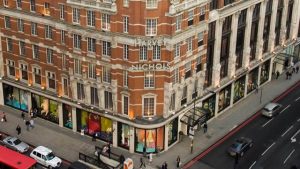
In London, department store, Harvey Nichols, is enticing customers into its stores and keeping them longer. It has invested a great deal in beauty and wellness, opening a new beauty lounge. As well as offering treatments such as LED facial, cryotherapy and vitamin and nutrient injections, the beauty lounge offer make-up masterclasses. It also makes a [pint of always having something exceptional to offer connected with these events.

A Harvey Nichols’s Department Store in London

The Future

Meanwhile a buying director of Liberty, which struggled for many years but is now trading profitability believes firmly  that department stores are here to stay, but says they have to offer a compelling reason for customers to visit. “I try to enhance all the things that you cannot get online-this means we offer advice and in-depth knowledge about our products. It is all about eccentricity and the story behind a product. “I also see us as neighbourhood store.”

McKee, with her experience of managing retailers on both UK and US, is a believer in the future of department stores, but says they need to remember that they “have to become the host or hostess, while the customer is the guest”.

What is indisputable is that no stores can expect to survive if, as The Future Laboratory’s Hardy puts it, “all they do is to try to sell us more stuff”.


Reference: Lucia van der Post, Retail of two cities, Financial Times, How to spend it, October 7 2017.

Privacy

Privacy Policy for The Blog of Dato’ Dr Anuar Md Nor

If you require any more information or have any questions about our privacy policy, please feel free to contact us by email at Privacy.

At www.datodranuar.com we consider the privacy of our visitors to be extremely important. This privacy policy document describes in detail the types of personal information is collected and recorded by www.datodranuar.com and how we use it.

Log Files
Like many other Web sites, www.datodranuar.com makes use of log files. These files merely logs visitors to the site – usually a standard procedure for hosting companies and a part of hosting services’s analytics. The information inside the log files includes internet protocol (IP) addresses, browser type, Internet Service Provider (ISP), date/time stamp, referring/exit pages, and possibly the number of clicks. This information is used to analyze trends, administer the site, track user’s movement around the site, and gather demographic information. IP addresses, and other such information are not linked to any information that is personally identifiable.

Cookies and Web Beacons
www.datodranuar.com uses cookies to store information about visitors’ preferences, to record user-specific information on which pages the site visitor accesses or visits, and to personalize or customize our web page content based upon visitors’ browser type or other information that the visitor sends via their browser.

DoubleClick DART Cookie

→ Google, as a third party vendor, uses cookies to serve ads on www.datodranuar.com.
→ Google’s use of the DART cookie enables it to serve ads to our site’s visitors based upon their visit to www.datodranuar.com and other sites on the Internet.
→ Users may opt out of the use of the DART cookie by visiting the Google ad and content network privacy policy at the following URL – http://www.google.com/privacy_ads.html

Our Advertising Partners

Some of our advertising partners may use cookies and web beacons on our site. Our advertising partners include …….

  • Google

While each of these advertising partners has their own Privacy Policy for their site, an updated and hyperlinked resource is maintained here: Privacy Policies.
You may consult this listing to find the privacy policy for each of the advertising partners of www.datodranuar.com.

These third-party ad servers or ad networks use technology in their respective advertisements and links that appear on www.datodranuar.com and which are sent directly to your browser. They automatically receive your IP address when this occurs. Other technologies (such as cookies, JavaScript, or Web Beacons) may also be used by our site’s third-party ad networks to measure the effectiveness of their advertising campaigns and/or to personalize the advertising content that you see on the site.

www.datodranuar.com has no access to or control over these cookies that are used by third-party advertisers.

Third Party Privacy Policies

You should consult the respective privacy policies of these third-party ad servers for more detailed information on their practices as well as for instructions about how to opt-out of certain practices. www.datodranuar.com’s privacy policy does not apply to, and we cannot control the activities of, such other advertisers or web sites. You may find a comprehensive listing of these privacy policies and their links here: Privacy Policy Links.

If you wish to disable cookies, you may do so through your individual browser options. More detailed information about cookie management with specific web browsers can be found at the browsers’ respective websites. What Are Cookies?

Children’s Information
We believe it is important to provide added protection for children online. We encourage parents and guardians to spend time online with their children to observe, participate in and/or monitor and guide their online activity. www.datodranuar.com does not knowingly collect any personally identifiable information from children under the age of 13. If a parent or guardian believes that www.datodranuar.com has in its database the personally-identifiable information of a child under the age of 13, please contact us immediately (using the contact in the first paragraph) and we will use our best efforts to promptly remove such information from our records.

Online Privacy Policy Only
This privacy policy applies only to our online activities and is valid for visitors to our website and regarding information shared and/or collected there. This policy does not apply to any information collected offline or via channels other than this website.

Consent
By using our website, you hereby consent to our privacy policy and agree to its terms.

Privacy Policy Online Approved Site

Update
This Privacy Policy was last updated on: Friday, November 24th, 2017.
Should we update, amend or make any changes to our privacy policy, those changes will be posted here.

Bio-Data of Dato’ Dr Anuar Md Nor

Dato’ Dr. Anuar is

the founder of Bison Consulting. He has been involved in the commercialization of technologies and the assessment of new innovation.

Dato’ Dr. Anuar has developed expertise in the valuation of new ventures during his long involvement as a private equity manager and investment analyst in Malaysia and Silicon Valley, USA. He also gained theoretical knowledge in the assessment of new innovation and venture teaching as a professor at the Azman Hashim International Business School, Universiti Teknologi Malaysia (UTM).

Dato’ Dr. Anuar has an engineering background as well as a business background. He has an undergraduate degree in Chemical Engineering from University of Birmingham, England, an MBA degree from School of Management, University of Bradford, England, an MSC in Management of Technology from Alfred Sloan School of Management, MIT, Boston, USA, and PhD in Business Management, specializing in strategic management, from Universiti Teknologi MARA (UiTM), Shah Alam, Malaysia.

He is an author of three books, Securing Private Equity in Malaysia, The Palm Oil Multinationals from Malaysia and Role of Network Relationships in Internationalization Process. The last two books are available from Amazon.com.