Last Thursday, we had the opportunity to review new technologies developed and shown at the Malaysian Technology Expo (MTE) 2018.
Those who are interested to know more on the technologies, please get in touch with me.
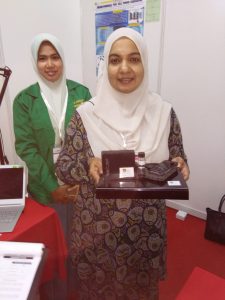
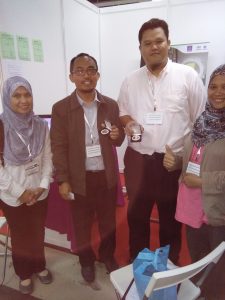
Prof. Ir. Dr Dr Siti Kartom Had Developed a Power Bank Using Fuel Cell Technology
This power bank, which uses fuel cell technology, is very useful in areas where there is no source of electricity supply.
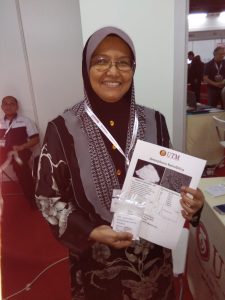
Prof. Dr. Noriah Had Developed Technology to Convert Waste Rice Husk into Amorphous Silica Using Laser
The technology she had developed is using laser to convert waste rice husk into amorphous silica. As the waste rice husk is completely converted, there is no residue in the process.
Assoc. Prof. Dr. Coswald Had Developed Formulation for Long-Lasting Denim Colour
The formulation is a dye that allows long-lasting blue colour of a denim.
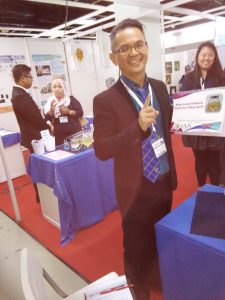
A Team from National Metrology Institute of Malaysia Had Developed a Standard to Verify Gold Purity
The technology involved a standard gold block to verify density and purity that can be used to detect fake gold.
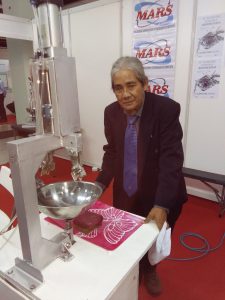
My Friend, Mr. Amir, a Fecund Inventor with His invention of Durian Opener
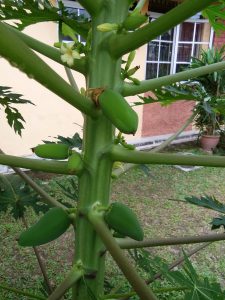
Several Fruits Growing Nicely.
Lastly, my papaya is growing nicely, having reached a size of 6-cm long since January 24th, 2018.
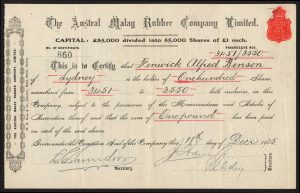
Certificate of Rubber Companies Listed on London Stock Exchange
Background
In the early phase of the rubber industry in early 1900s, investors and speculators floated companies, which owned rubber estates or rubber lands in Malaya, on the London Stock Exchange. Their estates in major states like Selangor and Negri Sembilan had English-sounding names. Some of the English-sounding names included:
Aranlife
Balgownie
Beaumont
Blackwater
Braemer
Broome
Brown Comet
Caledonian
Carey Island
Castlefield
Coalfields
Cullerlie
Colwall
Devon
Didsbury
Easrnor
Ebor
Edinburgh
Effingham
Emerald
Galloway
Glenmarie
Golconda
Golden Hope
Haron
Harfenden
Hawthornden
Haytor
Highland & Lowlands
Holmwood
Inch Kenneth
Kent
Killinghall
Lambourne
Ledbury
Lunderston
Madingley
Merton
Midlands
Monmouth
New Amherst
Newbury
North hammock
Paradise
Pilmoor
Reading
St Andrew’s
Seafield
Seaport
Sedgeley
Shelford
Sione
Strathmore
Strathnairlie
Tremelbye
Vallambrosa
Wardieburn
Waterfall
West Country
We remember many of names existed until in the 1970s, while other estates were absorbed by larger companies. With a shipping travel time of about 40 days between London and Singapore in early 1900s, the owners of the rubber estates in London would need local companies or local managers to oversee their rubber estates in Malaya.
Enter the Agency Houses
The early rubber planters used the fund, raised through the flotation of public companies on the London Stock Exchange, to develop their rubber estates. However, the costs involved in opening up new rubber plantation on a scale dictated by demand lay well beyond the means of almost all rubber planters. In addition, the rubber planters had to wait for at least five years before the rubber trees could be tapped for latex.
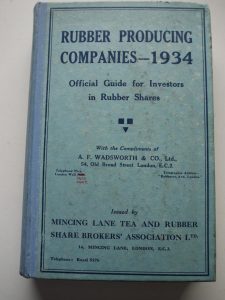
Mincing Lane in London Where Shares of Rubber Companies Were Traded
Those early rubber planters had to seek capital from other sources, namely the established merchant houses based in Singapore and Penang, which have been operating since 1800s. The established merchant houses had the right contacts on the local and overseas financial market. It also involved experiences of business organizations and management techniques, of which most planters were woefully lacking, and the know-how for shipping and marketing rubber on the London market.
The big merchant houses which started in early 1800s, eventually dominated the rubber industry which came to be known as agency houses. By the end of the second decade of twentieth century, the agency houses had established itself in a dominating position in the rubber plantation industry and later in the oil palm industry. However, it took a generation to consolidate their position. During this period, the early rubber planters made it to the boardroom of rubber companies which were listed on the London Stock Exchange and the rubber speculators from the City of London itself died off and were replaced by the nominees of the agency houses.
The largest Agency House Formerly Known as Harrison and Crosfield
The major agency houses that existed in 1960s included the following:
Agency Houses
No. of Companies
Number of Estates
Planted Areas (acres)
Harrison Crosfield
42
111
231,180
Guthrie
22
39
182,800
Boustead-Buttery
37
58
121,870
REA-Cumberbatch
37
55
97,560
T. Barlow
19
42
102,440
Sime Darby
23
30
73,900
Oriental Estates
14
19
55,140
Plantation Agencies
10
29
48,040
Whittal
22
28
45,210
Harper Gilfillan
16
18
35,560
Ethelburga Agencies
1
9
27,860
J Warren
16
21
26,070
SOCFIN
6
10
62,150
East Asiatic
4
4
21,100
Unitac
7
12
20,260
Other Agencies
5
7
21,040
Source: Zorn Leigh Hunt, Manual of Rubber Planting Companies, 1960, and Strait Times Directory, 1962. Quoted in Fryer (1964)
Guthrie, Another Large Agency House
There were several differences between the pattern of interests of the two largest agency houses, Harrison Crosfield and Guthrie. The first was by far the larger. Guthrie, however, appeared a much more specialized organization: it controlled relatively few companies and fewer estates than smaller rivals. The properties under its management, however, were of very large size, including both the largest rubber and oil palm estate in Malaysia. Guthrie had also a leading position in the cultivation of oil palm.
By the 1980s, the agency houses were bought over by Malaysian interests Several names such as Sime Darby, East Asiatic and Boustead are still operating under the new Malaysian owners until today.
As a business historian, we appreciate and value the contribution of individuals who managed these agency houses and created a plantation industry from the jungles of Malaya in the early 1900s.
Our thanks to Mr. Lampard, Mr. T. Barlow, Mr. Boustead Brothers, Sir John Hay, Mr. Money, Sir J. Anderson and others.
Reference:
J. M. Tate. The RGA History of the Plantation Industry in the Peninsular Malaysia. Oxford University Press, Kuala Lumpur, 1996.
Legend had it that four seed s of African Elaeis guineensis brought over by the Dutch into Indonesia in 1848 and planted in Bogor, Indonesia, laid the foundation for the palm industry in Malaysia and Indonesia. The two countries now produce more than eighty per cent of palm oil in the world.
The earliest record of four seedlings showed two originated from Burdoun (Reunion) or Mauritius and two from Amsterdam. The Government of Holland, who ruled Indonesia, actively promoted the usefulness of the oil palm tree and established experimental plots at Banjar Mas in Java and Palembang in Sumatra, Indonesia. It took another fifty years before an oil palm plantation was established.
The lack of enthusiasm of local authorities of Java and the doubts of planters both about the profitability and the milling methods to be employed held back the development of the oil palm industry. The technology for processing palm oil was finally invented in the early 1900s. At that time, oil palm had to compete with rubber, which was experiencing near-fever demand to make tires for cars.
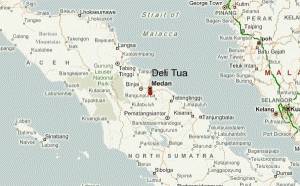
The foundation of the oil plantation industry is generally attributed to one M. Adrien Hallet, a Belgian with some knowledge of oil palm in Africa. He planted oil palms of Deli origin in 1911 on a large commercial oil palm plantation in Sumatra, Indonesia. Hallet recognized the avenue palm trees growing in Deli, near Medan, Indonesia, were more productive than the palm trees in Africa and also had superior fruit composition. Within three years, 2,600 hectares of oil palm trees were planted. However, the growing of oil palm trees stagnated during the First World War.
Deli, Near Medan in Indonesia Where Palm Oil Industry Started in Southeast Asia
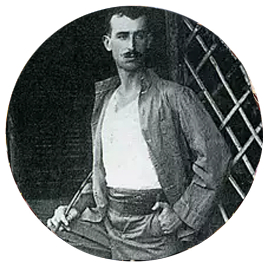
In the meantime, another planter, M.H. Fauconnier, a Frenchman, who had been associated with Hallet, planted oil palm trees in neighbouring Malaya during 1911 and 1912 at Rantau Panjang, Kuala Selangor, Selangor. The oil palms were in full bearing by 1917 and in that year the first seedling were planted on an area later to be known as Tennamaram Estate. When we visited the estate, the first oil palm trees in Malaya were no longer there as palm oil trees grow for about thirty years. Nevertheless, the progeny of these early oil palm trees built the foundation of the globally important palm oil industry.
M. H. Fauconnier, The Pioneer Oil Palm Planter in Malaya
Other Planters Took Notice
The second commercial oil palm plantation was established by Messr. Guthrie at Sungai Buloh, near Kuala Lumpur, which was known as Elmina Estate. The first palm oil processing mill was established by Sime Darby in 1925 at the Tennamaram Estate, which extracted crude palm oil from oil palm fruits. Over the years, due to the growing population of Kuala Lumpur, Elmina Estate became a housing area, and nearby the largest prison complex in Malaysia.
In the period when rubber dominated the agriculture sector in Malaya, a few planters with an eye to overseas markets began growing the oil palm. Although palm oil was used in the manufacture of soaps, margarine, vegetable oils and grease, there was little progress in the industry. After the slump in rubber prices after the First World War, rubber planters were forced to search for alternative crops. No large-scale development occurred until 1924, when three rubber companies in the Guthrie group formed Oil Palm Malaya Ltd. The example was followed by other planters. Because of the need for capital and special expertise, especially in processing of oil palm, the industry was confined to large plantations, using the then advantage of existing rubber industry infrastructure. In addition, the oil palm, which in Africa grew naturally in riverine forests or freshwater swamps, flourished in Malaya’s tropical climate. Without pronounced dry season, Malaya was a place where an oil palm tree could be planted throughout the year..
Following table highlights the key events in the palm oil industry
Date
Events
Impact
1875
Oil palm was introduced to Malaya as ornamental plants
The beginning of the oil palm industry
1903
First trial on planting oil palm in Batu Tiga, Selangor, by Malayan Department of Agriculture
The first agriculture research on oil palm in Malaya
1910
First commercial plantation of oil palm started in Nigeria
The start of oil palm plantation for export of crude palm oil
1911
First large-scale planting of oil palm by a Belgian company in Sumatra, Indonesia
The start of oil palm plantation in Southeast Asia
1917
First large plantings Malaya at Tennamaram Estate and Elmina Estate
The start of the commercial palm oil plantation Malaya
1953
Market pool system established by Malayan palm oil producers. Previously, palm oil was exported in drums.
The development of markets for Malayan palm by industry players to reduce shipping costs
1956
Establishment of FELDA, one of the largest palm companies in the world.
A Malayan government agency responsible to develop rubber and oil palm plantations.
1961
FELDA planted oil palm on a 350-hectare plot
This was followed by rapid expansion in areas planted with oil palm
1966
Malaysia (independent Malaya) overtook Nigeria as the world’s leading exporter of palm oil
Malaysia gained leadership in palm oil industry by pioneering many industry innovations
1972
Four palm oil refineries started operations
Start of processing industry to produce palm oil products for export markets
1979
Establishment of Palm Oil Research Institute of Malaysia (PORIM), now known as Malaysia Palm Oil Board
Start of a research institute specializing in palm oil industry
1980
Establishment of Kuala Lumpur Commodity Exchange
The exchange facilitates the trade in palm oil products
1981
Acquisition of Guthrie by Permodalan Nasional Bhd (PNB), a Malaysian government-owned investment company
The largest Brutish-owned plantation company was acquired by Malaysian interests
1981
Introduction of weevils, an insect from Cameroon, Africa, to pollinate oil palm trees
This new technique eliminates manual workers to pollinate oil palm trees. It increases the productivity of oil palm to bear fruits
1999
Guthrie established the first oil palm estate in Indonesia
The first purchase of a large piece of land in Indonesia by a Malaysian company
2000
Acquisition of a large listed plantation company in Indonesia by Guthrie
This expanded the plantation land owned by Malaysian companies.
2008
Mergers of three palm oil companies owned by PNB
Created the largest listed palm oil company in the world with more than 500,000 hectares. As a result, Guthrie ceased as a company.
Now
Indonesia is the largest producer of palm oil in the world
The country has more areas than Malaysia suitable for oil palm plantations
Source: Dato’ Anuar Md Nor, The palm oil multinationals from Malaysia. Lambert Academic Publishing , 2015.