
British Malaya (then Malaysia) used to be the major producer of natural rubber, gutta percha and tin. These three commodities made British Malaya an important British colony in the late 19th century and the early 20th century.
Natural rubber industry is no longer important in Malaysia, as rubber has been replaced by oil palm as the most important industrial crop in the country since the 1970s. However the economic and social impacts of the natural rubber industry have been very significant for Malaysians during the period from late 19th century to 1970s.
In the next few articles, we will be covering various aspects of the natural rubber industry, from its development in British Malaya, the innovators of the rubber products and the decline of the rubber industry. Every pupil in Malaysia knew that the seeds of rubber trees originally were smuggled out of Brazil. Later they came to British Malaya.
The first of the article is how I membered about rubber trees and daily activities revolving around rubber.
Rubber trees and daily tapping of latex
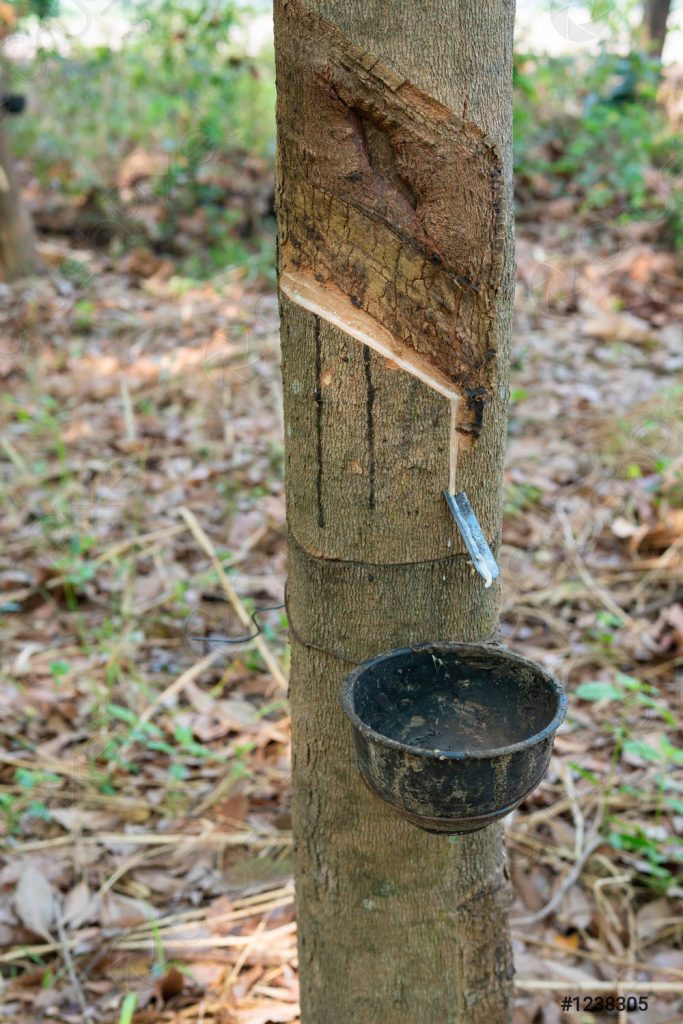
An early clone of rubber tree used to be able to be productive after 5 to 7 years. The bark needs to be tapped to allow the bark to “bleed” a white latex. The white latex is collected in a cup made of porcelain. The work of a rubber tapper started early in the morning at about 6 am. My parents used to have a small holding of rubber trees about a few kilometres from our home in Beranang, Selangor, Malaysia, in the 1960s. They cycled to the rubber small holding about 6.00 am, with a sharp rubber tapping knife. First, using a headlight light for illumination, they removed a thin slice of the rubber bark which was enough for the rubber latex to “bleed” and to be collected in the attached cup. They would take about an hour to complete the tapping of rubber trees in the small holding. By 8.00 am, the cups would be filled with white rubber latex. Then, they emptied the cups containing rubber latex to a big pail.
The pails would be placed onto the bicycle and transported to a communal rubber rolling centre. Every village would have a communal rolling centre to process the rubber latex into rubber sheets.
At the communal rolling centre, a measured amount of formic acid would be added to the rubber latex which had been poured into a special rectangular steel container. After a while, the rubber latex would coagulate, separating water from rubber. The rubber was still soft and about 4 to 5 cm thick. The soft block of rubber would be passed through an iron roller to reduce the thickness of rubber block to about 1 cm. The remaining water in the rubber block would have been completely removed after going through several times of rolling. Finally, the thin rubber sheet was dried in the sun to remove the remaining water. The dried drubber sheet would turn slightly brown after several days under the sun. The rubber was now ready to be sold for cash.
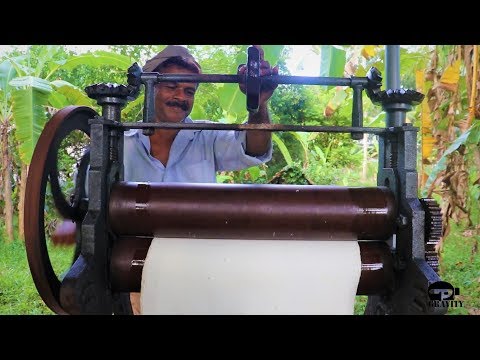
The tapping of rubber trees and the conversion of rubber latex into rubber sheets would take from 6 am to about 12.00 noon, every day.
After resting for lunch, most villagers would go to the their small paddy field to prepare their rice fields or to harvest their paddy. The rice filed would become their supplementary income after rubber sheets. In every town in Malaysia, there would be rubber dealers who would buy the rubber sheets at “discounted prices” after quality checks.
As expected, rubber small holders and the villagers were poor, surviving from selling of rubber sheets. This was compounded by the fluctuations of prices of rubber sheets on the world market. At time of high rubber prices, they would purchase a new bicycle for the family or a having “a feast” with the first-harvest of rice from the paddy field.
Rubber plantation companies were wealthy
The rubber small holding sector was a not a significant segment of the rubber industry. Rubber estates or plantations were much bigger with substantial acreage. The rubber estates boomed in the early 1900s to 1930’s when the motor industry emerged in Europe, US and Japan, thanks to Mr Henry Ford. In the early 1900s investment syndicates based in London drew investors, both individuals and institutions, to invest in rubber estates in British Malaya. At the time, British administrators in British Malaya opened up a vast area of forest to be cleared to plant rubber. Established British companies in British Malaya also attracted investors to buy smaller rubber estates to be consolidated into larger estates.
If we were to travel by car in British Malaya in the 1930s, rubber estates with British names would be scattered throughout British Malaya. These rubber estates would be managed by British planters, with the help of locals. They employ mostly Indian rubber tappers brought in from India, who were paid low salaries.
The larger rubber estates would have their own golf courses and social clubs. My wife’s late mother described the lives of the British planters vividly. She was about ten and lived in Rantau, Negeri Sembilan, Malaysia, where her village was surrounded by one of largest rubber estates in British Malaya.
“ Every evening, about 6 pm, I saw many cars, driven by Malay drivers, cruising to the Club in the centre of the town. The “missuses” of the British planters wore nice dresses, which were different from those worn by the local women.”
There was the days when rubber was the economic pillar of the economy of British Malaya.
Everyone knew that the rubber sheets sold to local rubber dealers would be destined to Europe. Very few would know that the innovations that led to the use of natural rubber into industrial products, notably tyres, were created much earlier in the mid of the 19th century. Many of these innovators went bankrupt many times during the innovative pursuits.
The next article would cover these innovators, which had transformed British Malaya from a nation of mainly forests to a modern economy driven by rubber trees. As Malaysians now, we should salute these innovators, such as the Hancocks of Marlborough and Charles Goodyear.