
Mining the Deep Sea Bed to Drive the Electric Car Revolution

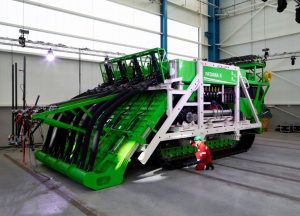
Patania II, owned by Dede of Belgium


Introduction

Today we noted two contrasting developments, 1) the price of Brent crude oil had fallen below US$60 per barrel, and 2) a company will start deep sea mining of precious metals.

In the 1980’s I worked as a refining planning engineer in ESSO’s refining unit in Port Dickson, Malaysia. During that time, as a refining planning engineer, I was tasked on production planning to refine Tapis crude, which was pumped from oil platforms located offshore in South China Sea.

Like crude oil before, precious metals used to make batteries for electric vehicles will also be mined from sea beds. According to a report in The Times London, Patania II, a 25-tonne robot tractor, will spearhead the latest push to mine precious metals from the ocean floor. Patania II would be lowered 4,500 metres to the Pacific Ocean sea bed between Mexico and Hawaii in April 2019. It will gather nodules of rock on the ocean floor that contain high concentrations of metals used in electric car batteries and renewable energy systems. The companies which are racing to mine the ocean floors are hoping to recover manganese, molybdenum, cobalt, nickel and vanadium. The companies contend that their deep sea mining operations would cause less environmental damage than producing the same mount on land by drilling and blasting millions of tonnes of rocks.

Britain is one of several countries sponsoring sea-bed mining companies that have obtained licenses from the International Seabed Authority (ISA), based in Jamaica, to explore the Clarion Clipperton Zone, an area in the Pacific Ocean covering about six million sq km. This area is thought to hold more of the metals being targeted than all terrestrial metal reserves (see our earlier blog). Access to its mineral reserves is controlled by the ISA because it is beyond the jurisdiction of any nation.

Chris Williams, the managing director of UK Sea Bed Resources, owned by Lockheed  Martin of the US, said that his company planned to mine about 9,000 sq km of the zone. “Sea bed mining will form an essential path to the future supply of precious metals for electric vehicles,” he said.

The ISA, however, needs to agree a mining code with environmental safeguards before extraction can begin. A draft has been produced to be agreed in 2020 but some of the ISA’s 168 members have a vested interest in delaying progress to protect their land-based mines from cheaper sea-bed minerals.

Environmental Concerns of Sea-Bed Mining    

The mining companies need to complete environmental impact assessments before starting extraction. The pilot operation of the Patania II, owned by Global Sea Mineral Resources (GSR), a subsidiary of the Belgian dredging company Dede, will leave nodules on the sea bed. A research vessel with 50 scientists on board, funded by EU, will study the impact. It is estimated that each nodule typically weighs about 1 kg and contains several different metals, meaning one sea-bed mine could deliver as many commodities as two or three land-based mines.

Polymetallic nodules containing several metals


The industry argues that sea-bed mining would reduce reliance on countries such as DRC, which produces most of the world’s cobalt for batteries.

Michael Lodge, the ISA’s British secretary-general, said that commercial extraction could start in 2023 but that depended on whether investors considered it as commercially viable. He added that some damage is inevitable but sea-bed mining was “the most highly regulated activity that’s never taken place”.

Watch out DRC on future development of sea-bed mining!

Please click below on polymetallic nodules published by the ISA.

Polymetallic nodules


Free eBook for Entrepreneurs: Increase Your Chance of Securing Fund from Investors

In 2010, we published a book, Securing Private Equity in Malaysia, as a guide for entrepreneurs on how to raise money from investors. We believe the book is still relevant today as it was in 2010.

In line with the forthcoming giving season, we want to make the ebook of the publication free to visitors of our website until December 31st, 2018.

Download the ebook by clicking below.

ebook Securing private equity in Malaysia

Yours sincerely,

Dato’ Dr Anuar Md Nor,

Founder/President, Bison Consulting


Move over Saudi Arabia, Russia and Venezuela: New Energy Giants are going to be Australia, Chile and DRC

Background

We noted an interesting article by Roger Boyes in the London Times on November 14th, 2018. He predicted that the push to produce electric cars worldwide would alter the dynamic of the existing energy-producing countries. The International Energy Agency has forecast that oil use by cars will peak in seven years because of the increasing number of drivers in emerging markets and Asia mega-cities. Then, electric vehicles will start to make a significant impact:300 million electric cars on the road by 2040. This will alter the energy value chain. The source of energy will shift from fossil fuel (crude oil) to mineral-based, namely lithium and cobalt to make powerful rechargeable batteries.

The Applications of Lithium

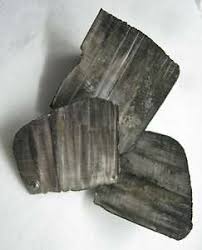
Spodumene, the main source of lithium

According to US Geological Survey, Mineral Commodity Summaries, January 2018 (The Report), global end-use markets of lithium are estimated as follow :

  1. Batteries, 46 per cent
  2. Ceramics and glass, 27 per cent,
  3. Lubricating greases, 7 per cent,
  4. Polymer production, 5 per cent,
  5. Continuous casting mould flux powders, 4 per cent,
  6. Air treatment, 2 per cent, and
  7. Other uses, 9 per cent.


Prices of Lithium

The Report noted that spot lithium carbonate in China ranged from US$15,000 to US$24,000 per ton throughout 2017 owing to tight supply of spodumene from Australia. The rest of the world experienced more modest price increases owing to supplies available from more diversified sources of lithium. Spodumene is a pyroxene mineral consisting of lithium aluminium inosilicate, LiAl(SiO₃)₂, and is a source of lithium. It occurs as colourless to yellowish, purplish, or lilac kunzite, yellowish-green or emerald-green hiddenite, prismatic crystals, often of great size.

Three spodumene operations in Australia and two brine operations each in Argentina and Chile accounted for the majority of world lithium production. The table below shows mine production and reserves of lithium.


Countries

Mine production in 2017 (Tons)

Estimated reserves (Tons)

US

35,000

Argentina

5,500

2,000,000

Australia

18,700

2,700,000

Brazil

200

48,000

Chile

14,100

7,500,000

China

3,000

3,200,000

Portugal

400

60,000

Zimbabwe

1,000

23,000

World total (excluding US)

43,000

16,000,000

Source: The Report


Australia, the main supplier of spodumene


Chile, a major supplier of lithium from brine operations

Owing to continuing exploration, lithium resources have increased substantially worldwide and total more than 53 million tons.

Substitutes

Substitution for lithium compounds is possible in batteries, ceramics, greases, and manufactured glass.


The Applications of Cobalt

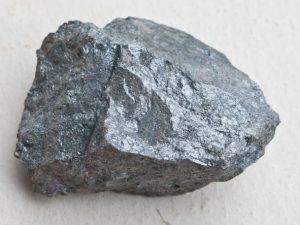
Cobalt mineral

According to The Report, Democratic Republic of Congo (DRC) is the leading source of mineral cobalt, supplying more than one-half of world cobalt mine production. With the exception of production in Morocco and artisanally mined cobalt in DRC, most cobalt is mined as a by-product of copper or nickel. In 2017, average annual cobalt prices more than doubled, owing to strong demand from consumers, limited availability of cobalt on the spot market, and an increase in metal purchases by investors.

China is the world’s leading producer of refined cobalt. Much of China’s production was from ore and partially-refined cobalt imported from DRC. China is the world’s leading consumer of cobalt, with nearly 80 per cent of its consumption being used by the rechargeable battery industry.

The table below shows mine production and reserves of cobalt.


Countries

Mine production in 2017 (Tons)

Estimated reserve (Tons)

US

650

23,000

Australia

5,000

1,200,000

Canada

4,300

250,000

DRC

64,000

3,500,000

Cuba

4,200

500,000

Madagascar

3,800

150,000

New Caledonia

2,800

Papua New Guinea

3,200

51,000

Philippines

4,000

280,000

Russia

5,600

250,000

South Africa

2,500

29,000

Zambia

2,900

270,000

Other countries

5,900

560,000

World total

110,000

7,100,000

Source: The Report


DRC is the biggest producer of cobalt and having the biggest reserves

The Report noted that terrestrial cobalt resources are about 25 million tons. In addition, more than 125 million tons of cobalt resources have been identified in manganese nodules and crusts on the floor of the Atlantic, Indian and Pacific Oceans.

Substitutes

In some applications, substitution for cobalt would result in a loss in product performance.


Conclusion

The electric car revolution would increase the consumption of cobalt and lithium, and the reduction in the consumption of petrol from crude oil. These mean countries such as Australia, Argentina, Chile and DRC would be the new energy giants in the next decades. What would the existing energy giants such as Saudi Arabia, Russia and Venezuela do with their plentiful reserves of crude oil?

Robots Making Robots

Factory Runs By Robots to Make Robots

Swiss robotics company ABB has revealed that it’s spending US$150 million to build an advanced robotics factory in Shanghai — one that will use robots to build robots. The company will rely on its YuMi single-arm robots, which it once used to conduct an orchestra, for small parts assembly. It also plans to make extensive use”of its SafeMove2 software in the facility, which it says will allow its YuMi models and other automated machines to safely work in close proximity with human employees.

ABB says its goal is to make the Shanghai facility the most advanced robotics factory in the world. It will even feature a Research and Development center to accelerate the firm’s work in artificial intelligence. In addition, it will widen the types and variants of robots the company can build for Chinese companies, including automakers and electronics manufacturers. China is ABB’s second biggest market after the United States, and the new factory could greatly expand its presence in the market. The company expects to open the 75,000-square-foot facility by late 2020.

The Status of World’s Robots Population

According to the International Federation of Robotics (IFR) 2018 Report, there are three types of robots;

  1. Industrial Robots
  2. Professional service robots, and
  3. Personal/domestic services robots

The IFR 2018 reports noted key drivers for robots, and they include:

  • Shift to high mix/low volume production
  • Global competitiveness
  • Digitalization of manufacturing-Industry 4.0.
  • Growing consumer market
  • Energy efficiency-driven technology shift
  • Regionalized production

Industrial Robots

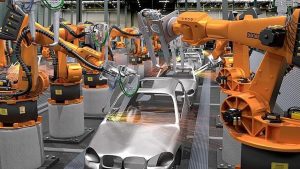
Automotive industry uses the most number of industrial robots

In 2017, China was the biggest supplier of industrial robots with 138,00 units followed by Japan at 46,000 units. The main customers of industrial robots are the automotive industry and the electrical and electronic industry. However, China was lower in the ranking in the number of installed robots per 10,000 employees in the manufacturing industry in 2017, as shown below:

  Country Installed robots
1 Korea 710
2 Singapore 658
3 Germany 322
4 Japan 308
5 Sweden 240
6 Denmark 230
7 US 200
8 Taiwan 197
9 Belgium 192
10 Italy 190
11 Netherlands 172
12 Austria 167
13 Canada 161
14 Spain 157
15 Slovakia 151
16 Slovenia 144
17 Finland 139
18 France 137
19 Switzerland 129
20 Czech Republic 119
21 China 97


In 2017, there were 2,098,00 industrial robots in world’s factories as compared to 1,632,000 in 2015.

Professional Services Robots

A professional service robot

According to IFR 2018 Report, there were sales of US$6.6 billion of professional service robots in 2017, representing 109,500 units. The main applications were in the logistics, medical, field and defence sectors. AGVs were used in factories, warehouses, logistics centres and hospitals. Medical robots are most valuable with 2,900 units representing sales of US$1.9 billion in 2017. Field robots are mainly milking robots.

Personal/Domestic Service Robots

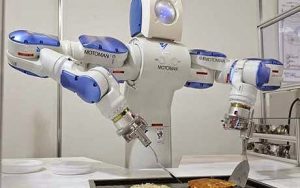
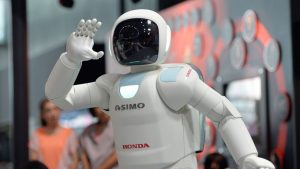
ASIMO, a leisure robot

Vacuuming and floor cleaning robots are mostly established personal/domestic robots. In 2017, there were 1,200,000 household robots and 400,000 entertainment and leisure robots.

 Please find a snapshot of the robotic industry in the report below.

WR_Presentation_Industry_and_Service_Robots_18_Oct_2018